Customer Feedback Analytics vs. Management: What's the Difference?
Customer feedback management collects what customers say. Customer feedback analytics tells you why it matters. Here's how to build a feedback stack that does both without replacing your current systems.
Customer feedback management (CFM) collects and organizes responses across channels, including surveys, reviews, support tickets, and social media.
Customer feedback analytics extracts the insights that drive decisions by discovering themes, measuring business impact, and spotting emerging issues early.
Modern enterprises need both capabilities, but they don't need to come from the same platform.
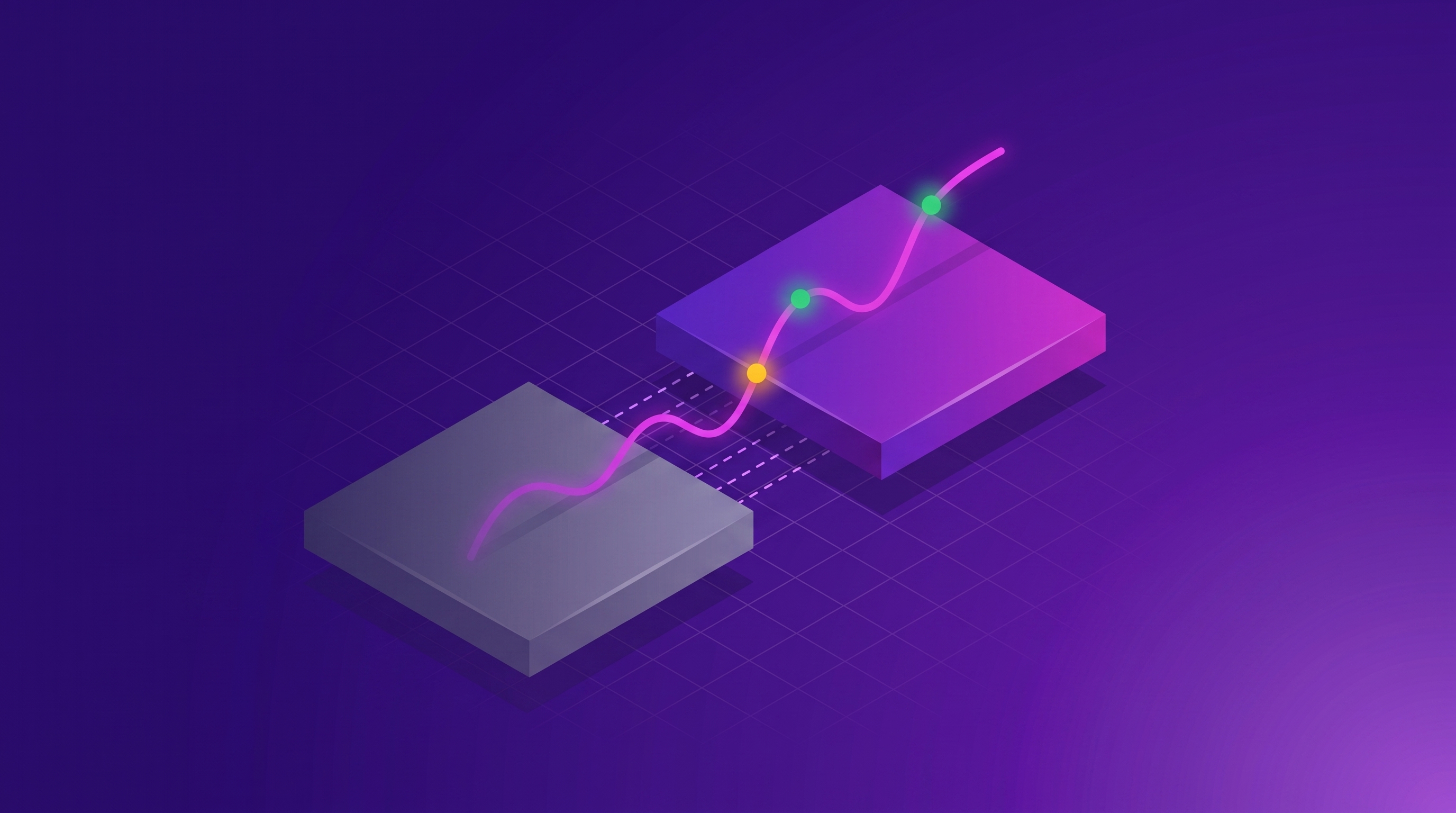
The "analytics layer" approach mirrors your data stack: just as you separate data warehousing from BI tools, you can layer dedicated analytics on top of existing CFM platforms.
Companies add dedicated analytics layers like Thematic on top of Medallia, Qualtrics, and other CFM platforms to achieve research-grade insights in hours instead of weeks, delivering 543% ROI without replacing current systems.
What is customer feedback management?
Customer feedback management (CFM) is software that collects and organizes customer feedback across all channels. CFM platforms like Medallia, Qualtrics, and InMoment gather responses from surveys, reviews, support tickets, and social media into centralized systems.
These platforms manage the practical side of feedback collection. They send surveys at the right touchpoints, manage response rates, close the loop with customers, and provide dashboards showing what customers said. If you need to trigger a follow-up email when someone gives a low score, CFM platforms handle that workflow.
CFM platforms ensure no customer voice gets lost and every response reaches the right team member. They excel at answering 'what did customers say?
The next question—"why does it matter?"—is where analytics comes in.
What is customer feedback analytics?
Customer feedback analytics is software that extracts insights and themes from collected feedback. Customer feedback analytics platforms like Thematic use AI to discover themes, quantify sentiment, measure business impact, and spot emerging issues early.
Analysis goes deeper than counting mentions or sorting by star rating. It identifies that "slow service" and "took forever" express the same frustration. It distinguishes between "expensive" meaning "competitors are cheaper" versus "expensive" meaning "good value but I can't afford it right now."
Modern analytics platforms combine traditional text analytics with large language models (LLMs) and generative AI, selecting the best approach for each task. This hybrid approach means you get consistent accuracy whether you're analyzing structured survey responses or freeform support tickets.
Thematic applies this hybrid AI approach to provide transparent, research-grade analysis that sits on top of existing CFM and contact center tools. This helps enterprises discover themes automatically, quantify their business impact, and deliver insights analysts can defend to executives.
The right analysis platform also shows you the business impact. Not just "pricing is mentioned 500 times" but "pricing issues cost you 2.3 NPS points and affect your highest-value customer segment disproportionately."
According to the Forrester Total Economic Impact Study, companies using dedicated feedback analysis capabilities achieve 543% ROI over three years, with $652,000 in annual savings from automated analysis that previously required manual effort.
Customer feedback management vs. customer feedback analytics: Side-by-side comparison
The answer depends on your feedback volume and how deep your analysis needs to go.
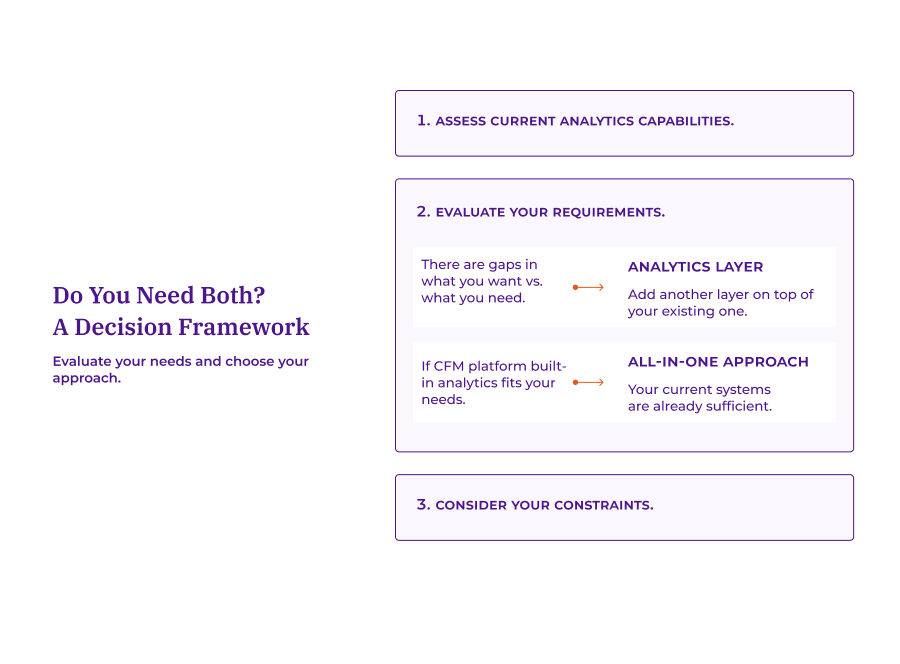
A framework for deciding whether to add an analytics layer or stay with your current approach.
Step 1: Assess your current analytics capabilities
Can your CFM platform analyze all your feedback sources (surveys, reviews, social media, support tickets)?
Can you see how themes are created and validate the methodology?
How quickly can you get from feedback to actionable insights?
Step 2: Evaluate your requirements
Do your insights teams need to explain methodology to executives?
Do you need to discover unexpected themes, or just track predefined categories?
Do you need to quantify business impact (which themes affect NPS/CSAT and by how much)?
Step 3: Consider your constraints
Is vendor consolidation a priority for your organization?
Does bundle pricing with your existing CFM vendor matter more than analytical depth?
Can your team adapt to specialized tools, or do you need everything in one platform?
If you see gaps between what you have and what you need, consider adding a dedicated analytics layer. If your CFM platform's built-in analytics meet your needs, the all-in-one approach may be sufficient.
When the all-in-one approach works
For some organizations, keeping everything in one platform makes sense. This approach typically fits when:
Your feedback environment is straightforward (primarily surveys from one platform)
Your CFM platform's built-in analytics meet your depth requirements
Bundle pricing with your existing vendor makes financial sense
You're prioritizing vendor consolidation over analytical depth
This approach works for many enterprises. It simplifies procurement and reduces the number of platforms to manage.
When the analytics layer approach works
Your CFM platform's text analytics feels like a black box you can't validate
You need to analyze feedback sources your CFM doesn't cover (app reviews, social media, chat transcripts)
Your insights team needs transparent AI they can defend to executives
You want to discover themes you didn't know to look for, not just track predefined categories
For example, Thematic serves as a feedback intelligence layer for enterprises managing feedback across Medallia, Qualtrics, and contact center platforms. It connects to existing systems through native integrations, applies transparent AI that analysts can validate and edit, and delivers research-grade insights without replacing collection infrastructure.
This approach lets insights teams unify analysis across all feedback sources while maintaining the analytical rigor executives expect.
Organizations choose dedicated analytics when they care about how themes are built and don't trust black-box AI. They succeed when they're willing to separate feedback analytics from their all-in-one CX platform.
Both approaches are valid. The decision comes down to whether your CFM platform's analytics capabilities match your analytical requirements.
The feedback intelligence layer: How feedback analytics sits on top of feedback management
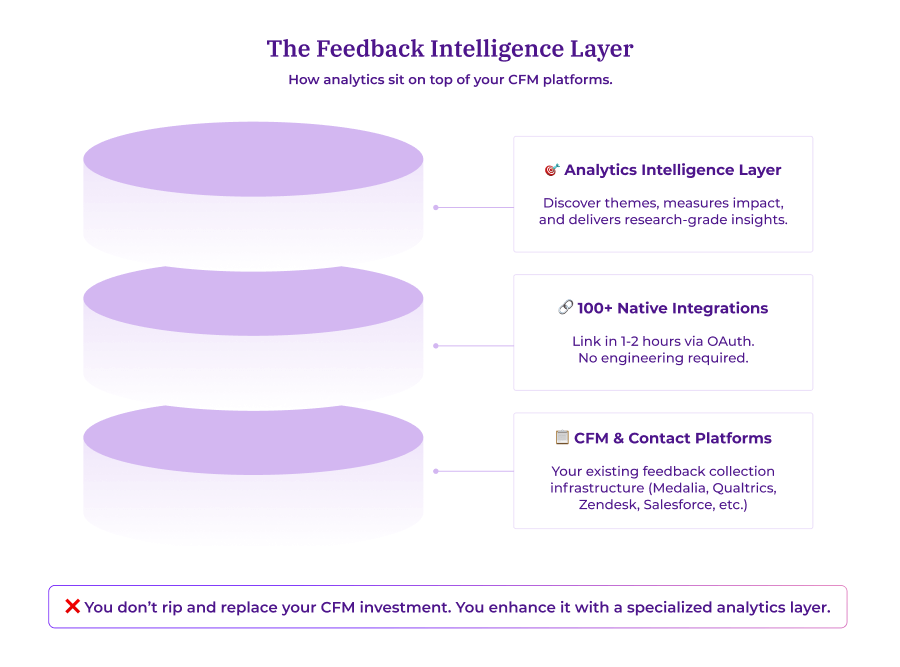
A customer feedback intelligence layer is specialized analytics software that connects to your existing CFM or contact center platforms and applies research-grade AI to extract themes and measure their impact. It doesn't replace your collection systems.
How a dedicated analytics layer sits on top of your existing CFM infrastructure.
Think of it like your modern data stack. Your data warehouse (Snowflake, BigQuery) stores data. Your BI tool (Tableau, Looker) extracts insights.
They work together, each doing what it does best. Your feedback stack works the same way: CFM platforms handle collection while dedicated analytics layers handle insight extraction.
You've already seen this approach work in your data infrastructure. As we explored in our guide to voice of customer and the modern data stack, the same principles apply to customer feedback. You separate storage from analysis, letting each layer do what it does best.
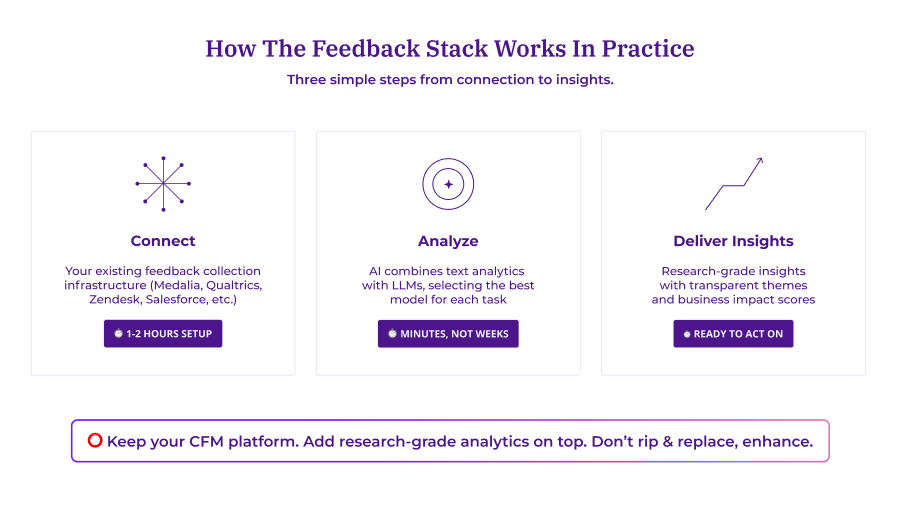
Here's how the feedback stack works in practice:
Three steps from connection to insights: connect your existing platforms, analyze with AI, and deliver research-grade insights.
First, the analytics layer connects to your existing platforms through native integrations. For platforms like Qualtrics, Zendesk, and Salesforce, this takes 1-2 hours using OAuth authentication.
For custom systems, API integrations typically take days, not weeks. Thematic offers dozens of native integrations with major CFM platforms, contact centers, and review sites. This makes it simple to unify feedback analysis across your entire stack.
Once connected, the analytics layer applies AI that combines traditional text analytics with LLMs, selecting the best model for each analytical task based on accuracy, speed, and cost.
This hybrid approach delivers both the reliability of proven methods and the sophistication of modern AI.
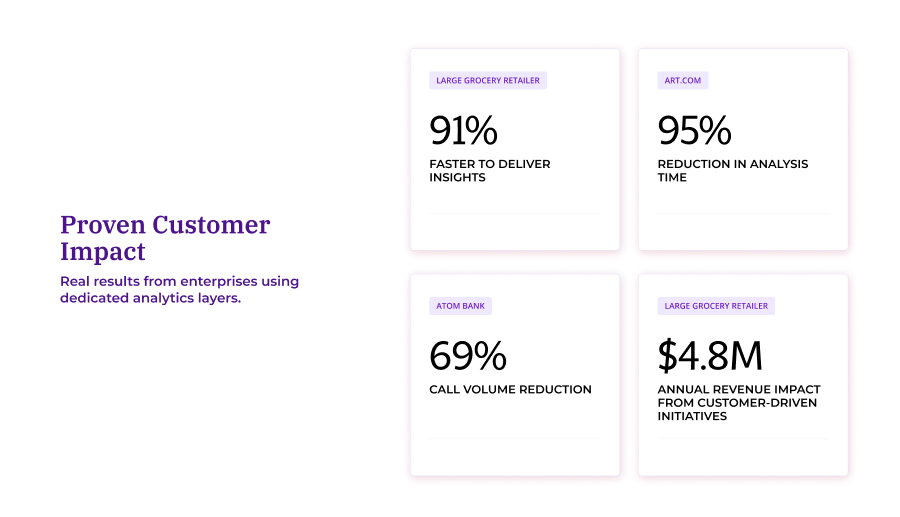
The analysis happens in hours, not weeks. Art.com reduced their analysis time from 20 hours to 1 hour after implementing an analytics layer alongside their existing survey platform. Art.com noted "there was nothing to download, no 4-6 week implementation timeline. There was only a login needed."
"With Thematic's Zendesk integration it was simple to set up and we immediately started seeing real, actionable and specific product issues that were affecting us," says Aaron Eddington, Serato's support manager.
Young Ly, CEO of Serato, adds: "With Thematic it is possible to get a much better idea of what the mood and importance of issues are to our customers. Armed with this I can enter discussions with industry partners knowing where the balance is on issues that affect us all.”
Thematic's dashboard showing theme discovery and AI-generated insights about customer feedback.
Here's the key benefit: you keep your CFM platform and add research-grade analytics on top. You don't rip and replace. You enhance.
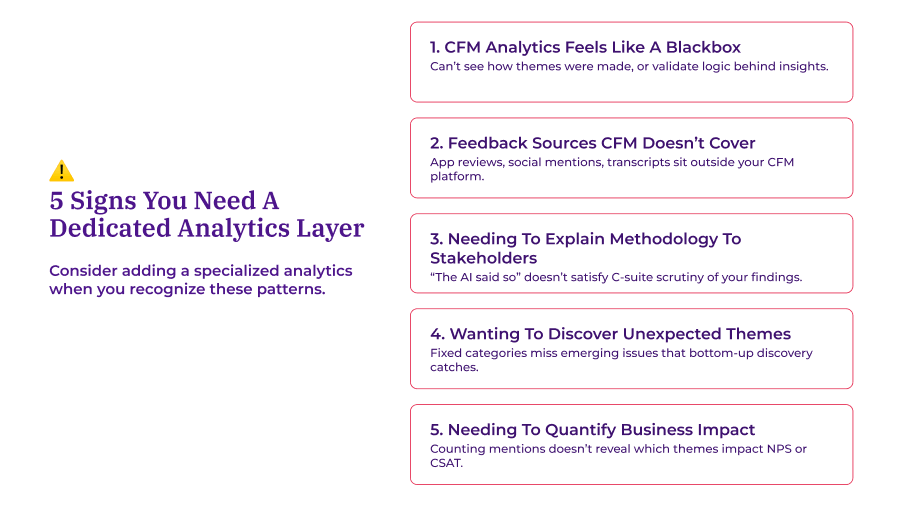
Signs you need a dedicated analytics layer
Consider adding an analytics layer when you recognize these patterns:
Warning signs that your CFM platform's built-in analytics aren't enough.
1. Your CFM's built-in analytics feels like a black box
You can't see how themes were created or validate the logic behind insights. When executives challenge your findings, you can't show your work.
With the right platform, you get complete transparency. You can trace every theme back to specific customer comments and modify the analysis if needed.
2. You have feedback sources your CFM doesn't cover
App reviews live in the App Store. Social mentions sit in Sprinklr. Chat transcripts stay in Intercom. Your CFM handles surveys beautifully but can't unify everything.
A large grocery retailer faced exactly this challenge with Medallia. Unable to analyze multiple datasets in their existing platform, they could only work with structured survey responses. After adding an analytics layer, they achieved 92% faster insights while analyzing all feedback types.
3. Your insights team needs to explain methodology to executives
Executives expect to see methodology, not just conclusions. You need to show statistical significance, sample sizes, and confidence intervals.
4. You want to discover themes you didn't know to look for
Predefined categories miss emerging issues. "Billing problems" might hide ten distinct sub-issues with different business impacts.
Bottom-up theme discovery catches these nuances automatically. The Forrester study found organizations automate 4,250 hours of manual work annually. Bottom-up theme discovery catches patterns manual analysis would miss.
5. You need to quantify impact on business metrics, not just count mentions
Knowing "delivery speed" was mentioned 800 times doesn't tell you it's costing 1.2 NPS points.
Thematic's impact analysis shows exactly how each theme affects your metrics, letting you prioritize fixes by business impact rather than volume.
The pattern is clear: enterprises add analytics layers when their CFM platform's built-in analytics don't give them the depth they need.
Real results from enterprises using dedicated analytics layers.
Making the right choice for your organization
The distinction between customer feedback management and customer feedback analysis isn't about which one is better. It's about matching your feedback stack to what you actually need.
If your CFM platform's built-in analytics give you the depth, transparency, and speed you need, the all-in-one approach makes sense. But if you find yourself waiting weeks for insights, unable to validate how themes were created, or missing feedback sources your CFM doesn't cover, a dedicated analytics layer delivers better results without replacing your current systems.
See how Thematic works: Thematic connects to 100+ data sources including Medallia, Qualtrics, Zendesk, and Salesforce. Book a demo to see how enterprises achieve significant ROI by layering transparent, research-grade analytics on top of their current CFM investment
Frequently asked questions (FAQs)
1. Is customer feedback analytics the same as customer feedback analysis?
These terms are used interchangeably in the industry. Both refer to extracting insights and themes from collected feedback. The key distinction is between collection (management) and insight extraction (analytics/analysis), not between the two analysis terms.
Thematic provides AI-powered customer feedback analysis that discovers themes automatically, measures their impact on business metrics, and unifies feedback from 100+ sources. This gives enterprise insights teams the depth they need to make confident decisions.
2. What's the difference between customer feedback management software and customer feedback analysis software?
CFM software collects feedback; analysis software tells you what it means. The key insight: most enterprises don't choose between them; they use both together.
They keep their CFM platform (Medallia, Qualtrics) for collection and workflows, then layer dedicated analytics on top when they hit limits: can't explain why metrics moved, can't analyze feedback from sources outside the CFM, or can't validate insights when executives ask "how do you know?"
This analytics layer approach means you enhance capabilities without replacing systems.
3. How accurate is AI-powered customer feedback analysis?
Modern AI-powered feedback analysis platforms achieve 80%+ accuracy out-of-the-box when discovering themes automatically. This accuracy improves with human-in-the-loop validation, where analysts refine themes through transparent editing.
Thematic combines automated theme discovery with transparent human-in-the-loop validation. Research teams can verify and refine themes through an intuitive editor, ensuring research-grade results analysts can defend to executives.
Some platforms provide outputs without visibility into methodology. Look for platforms that show their work and let you validate findings.
4. How do I get started with AI-powered customer feedback analysis?
Start by auditing your current feedback stack. Identify what collects feedback (your CFM platform, review sites, support systems) and what analyzes it (built-in CFM analytics, manual processes, spreadsheets).
Then figure out whether your current analysis gives you what you need. Can you discover unexpected themes? Quantify business impact? Get insights in hours instead of weeks?
If you identify gaps, an analytics layer may help. With native connectors, setup takes 1-2 hours. Art.com noted there was no lengthy implementation timeline, just a login and immediate value.
5. What makes Thematic different from traditional CFM platform analytics?
Thematic focuses on analytical depth rather than trying to be an all-in-one solution. It combines multiple AI approaches for accuracy while giving you transparent, human-in-the-loop control to validate every insight.
The platform connects to existing CFM systems through 100+ native integrations, working alongside Qualtrics, Medallia, and Zendesk.
6. Can customer feedback management platforms do both collection and analysis?
Many CFM platforms offer both collection and built-in analytics. However, the depth and sophistication of their analytics varies significantly.
Some enterprises find their CFM platform's analytics sufficient for their needs. Others discover the built-in capabilities don't offer the analytical depth, transparency, or flexibility their insights teams require.
The question isn't whether CFM platforms can do analysis. It's whether they do it at the level your organization needs. If you find yourself waiting weeks for insights, unable to analyze all your feedback sources, or struggling to explain methodology to executives, those are signals that dedicated analytics capabilities might deliver better results.
The modern approach treats this as a "best-of-breed" question rather than an either/or choice. You can keep your CFM platform for what it does well (collection, workflows, closed-loop) while adding specialized analytics for deeper insight extraction.
7. Should I choose customer feedback management or customer feedback analysis software?
This isn't an either/or choice. Modern enterprises need both capabilities. The question is whether you get both from one platform or layer them separately.
Choose an all-in-one CFM platform when your feedback environment is straightforward and your analytical needs are met by built-in capabilities.
Choose a separate analytics layer when you need transparent AI you can defend to executives, want to unify feedback sources your CFM doesn't cover, or require deeper analysis for theme discovery and impact measurement.
Share
Link Copied!
Request a demo of Thematic's Customer Intelligence Platform
Thematic turns fragmented feedback into one consistent source of customer truth — so every team acts on the same customer story. Up and running in days, not quarters.
Thank you! Your submission has been received!
Oops! Something went wrong while submitting the form.