AI can analyze thousands of customer comments in minutes, but if you can't explain how it works, your team won't trust the insights. This guide breaks down how AI theme discovery identifies patterns, what "accuracy" really means, and the questions to ask any vendor before buying.
AI theme discovery uses semantic understanding to group feedback by meaning, not just keywords. It recognizes that "laggy," "slow," and "takes forever" all describe the same issue.
Modern tools like Thematic achieve 80%+ accuracy out of the box, matching trained human coders.
Transparency is the key differentiator: Thematic shows exactly which phrases map to each theme, so you can validate the AI's work and refine results.
If a vendor can't explain their methodology, that's a red flag.
You've heard the promise: AI can analyze thousands of customer comments and surface the themes that matter. But when you ask how it actually works, the answers often get vague.
That's a problem. If you can't explain how the AI works, your team won't trust it. And if they don't trust it, they won't act on it.
LendingTree learned this when evaluating feedback analysis tools. They always had to process over 20,000 comments in a 90 day period and needed their product teams to actually use the insights.
They chose Thematic as their customer feedback analysis and management solution specifically because the AI shows its work: every theme traces back to specific customer comments.
This guide breaks down how AI theme discovery actually works, what "accuracy" really means, and the questions you should ask any vendor before buying.
How does AI identify themes in customer feedback?
AI theme discovery uses a combination of text analytics and large language models (LLMs) to read customer feedback, understand the meaning behind words, and automatically group similar responses into themes.
Unlike manual coding, AI can process thousands of responses in minutes while maintaining consistency.
Semantic understanding vs. keyword matching
Basic text analysis looks for exact words. If a customer writes "slow," it counts "slow." But customers rarely use the same words to describe the same problem.
"The app takes forever to load."
"Super laggy experience."
"I waited 30 seconds just to see my dashboard."
These all describe the same issue. Keyword matching would scatter them across different buckets.
Semantic understanding solves this.
AI trained on language patterns recognizes that "takes forever," "laggy," and "waited 30 seconds" share a common meaning. It groups them into a single theme like "slow loading times."
Sentiment tells you customers are frustrated. Thematic analysis tells you why.
Why training data matters
AI models learn from examples, making training data valuable.
A model trained on news articles will struggle with customer feedback's informal, fragmented language.
"App crashes when I try to checkout!!!" doesn't follow the same patterns as a newspaper article.
The best customer feedback analysis tools are trained specifically on feedback sources like: surveys, support tickets, reviews.
Thematic combines traditional text analytics with LLMs, selecting the best approach for each task. The platform has been refined over years of real-world feedback analysis and continuously adopts the latest AI models.
The role of transparency
Many AI tools give you themes but can't explain why a specific comment was assigned to a specific theme.
Transparent tools show their work.
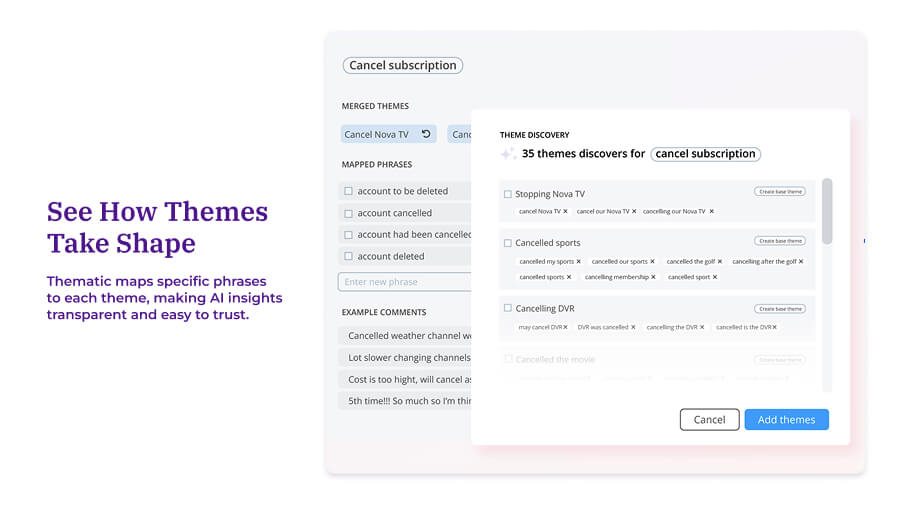
In Thematic, each theme includes mapped phrases: the specific words the AI associates with that theme. You can see that "takes forever" and "laggy" both map to "app performance."
Thematic maps specific phrases to each theme, making AI insights transparent and easy to trust.
This visibility lets you validate the AI's work and refine themes using the Themes Editor to match your company's terminology.
How accurate is AI theme identification?
Modern AI theme discovery tools like Thematic achieve 80%+ accuracy out of the box, comparable to trained human coders.
The key differentiator is transparency: the best tools show exactly why each piece of feedback was assigned to a theme, allowing you to validate and refine results.
What "accuracy" actually means
In theme identification, there's no single "correct" answer. Give 5 analysts the same 100 comments, and they'll create different theme structures.
Academics measure this using inter-rater reliability: how consistently different coders categorize the same content.
That's not a typo. Even trained analysts often disagree on how to categorize the same piece of feedback.
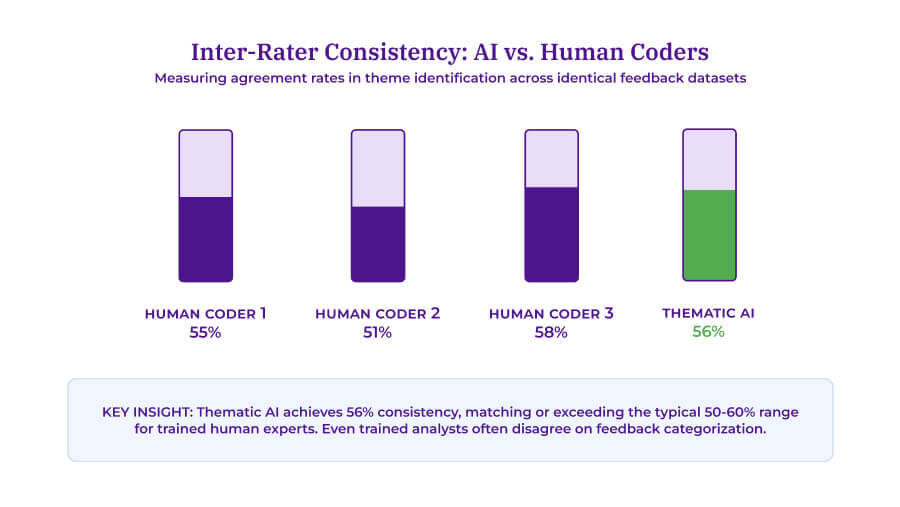
The same research found that Thematic's AI matches or exceeds human consistency. In some tests, Thematic agreed with human coders more than the humans agreed with each other.
Thematic AI achieves 56% consistency, matching the typical range for trained human coders who often disagree on feedback categorization.
Realistic benchmarks
80%+ accuracy out of the box: No training required. Upload your data and get usable themes immediately.
90%+ accuracy with refinement: A few hours of human review can push accuracy higher than most manual coding.
100% accuracy is a myth: Even humans don't achieve this. Anyone claiming 100% accuracy isn't being honest.
100% accuracy isn't being honest.
Greyhound experienced this firsthand. They reduced feedback analysis time tenfold, from days of manual work to minutes. "More importantly, Thematic surfaced insights their manual process had been missing, including overwhelmingly positive driver feedback that had been buried in the data.Why black-box AI is a red flag
Some vendors can't explain how their AI reaches conclusions. This makes validation impossible and creates real problems when you need to defend insights to executives.
With black-box tools, there's no way to trace your steps back when leadership asks "how do we know this is accurate?"
Transparent tools let you click on any theme and see the exact comments and phrases that support it.
Transparency isn't a nice-to-have. It's how you build confidence that your customer intelligence is reliable.
The Forrester Total Economic Impact study found that companies using Thematic achieved 543% ROI over 3 years, in part because teams actually trusted and acted on the insights.
What should I ask vendors about AI feedback theming?
When evaluating AI feedback theming solutions, ask to see how themes are created, how accuracy is measured, and whether you can trace any insight back to the original customer comments.
If a vendor struggles to answer these questions clearly, it may indicate their tool lacks the transparency you need.
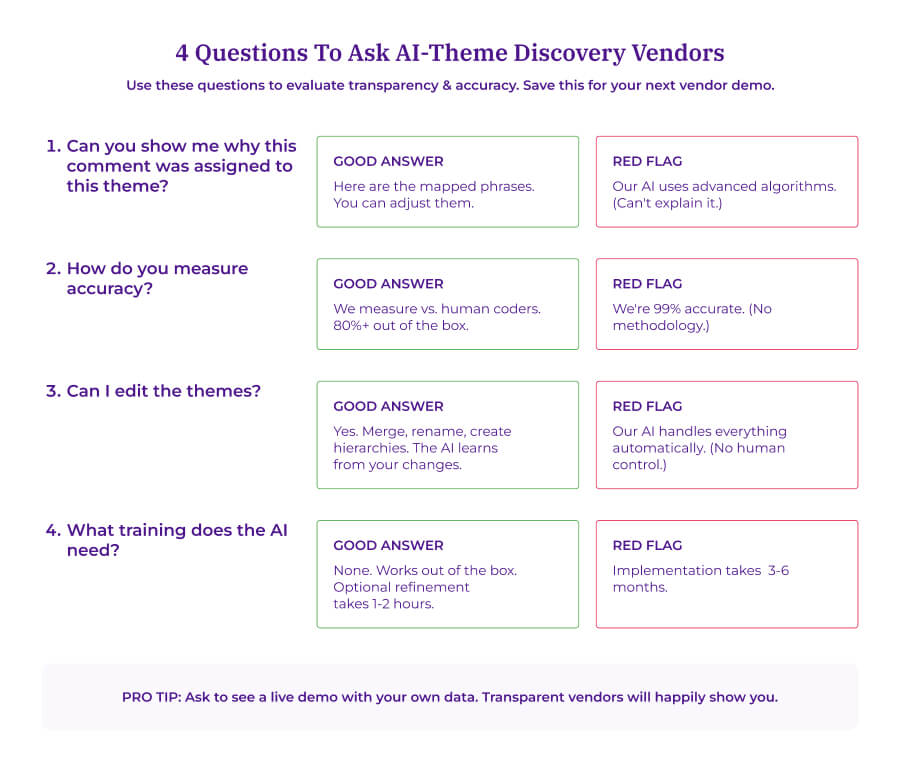
Use these four questions to evaluate transparency and accuracy when comparing AI theme discovery vendors.
1. "Can you show me why this comment was assigned to this theme?"
Good answer: "Yes. Here are the mapped phrases that triggered this assignment. You can adjust them if needed."
Red flag: "Our AI uses advanced algorithms to determine themes." (Translation: we can't explain it.)
2. "How do you measure accuracy?"
Good answer: "We measure consistency against human coders. Our accuracy is 80%+ out of the box."
Red flag: "We're 99% accurate" with no methodology to back it up.
3. "Can I refine or edit the themes?"
Good answer: "Absolutely. You can merge themes, rename them, and adjust the mapped phrases."
Red flag: "Our AI handles everything automatically." (No human-in-the-loop means no way to fix mistakes.)
4. "What training does the AI require?"
Good answer: "None required. The AI works out of the box. You can optionally refine themes, which takes 1 to 2 hours."
Red flag: "Implementation takes 3 to 6 months." (Question whether it's actually AI or just manual rules.)
LendingTree chose Thematic because it "works straight out of the box." They handle 20,000+ comments across 7 product verticals without any setup time.
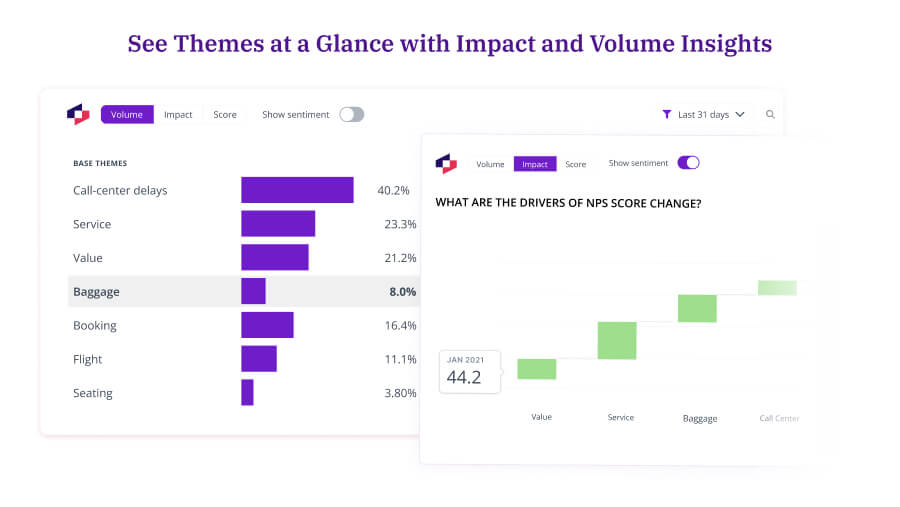
See themes at a glance with volume percentages and NPS impact insights.
Where to go from here
AI theme discovery works. The technology matches human accuracy while processing feedback in minutes instead of weeks.
But not all AI tools are equal. The difference comes down to transparency.
Can you see how themes are built?
Can you trace insights back to original comments?
Can you refine the output?
If yes, you've found a tool worth evaluating.
If no, keep looking.
Want to customize your themes for better results? Check out these guides:
You can also book a demo to see AI theme discovery on your own feedback data.
Frequently asked questions
How long does it take to set up AI theme discovery?
With modern AI feedback theming platforms like Thematic, it takes minutes to hours rather than weeks to set up.
Upload your data or connect your survey tool, and the AI generates themes immediately. LendingTree described Thematic as working "straight out of the box" with no setup time required.
Do I need to train the AI on my data?
No. Modern AI customer feedback analysis tools like Thematic work out of the box because they're pre-trained on large volumes of customer feedback data. Refinement is optional and typically takes just 1 to 2 hours if you want to customize themes to your terminology.
How is AI theming different from keyword analysis?
Keyword analysis simply counts how often specific words appear. AI theming goes deeper by using natural language processing to understand meaning. For example, "slow," "laggy," and "takes forever" are different keywords, but AI recognizes they describe the same underlying issue and groups them into a single theme. This semantic understanding is what makes AI theming more accurate and actionable than basic keyword counting.
What if the AI gets a theme wrong?
When AI misassigns a comment, the impact depends on your tool's transparency. With black-box tools, you may not even notice errors, and there's no way to correct them.
With transparent tools like Thematic, you can spot misassignments by reviewing the mapped phrases. To fix it, you simply adjust the phrases that trigger the theme assignment, merge similar themes, or split overly broad ones. The AI then learns from your changes and applies them to future analysis.
Share
Link Copied!
Request a demo of Thematic's Customer Intelligence Platform
Thematic turns fragmented feedback into one consistent source of customer truth — so every team acts on the same customer story. Up and running in days, not quarters.
Thank you! Your submission has been received!
Oops! Something went wrong while submitting the form.