Which Customer Feedback Analytics Tool Is Best for Analyzing NPS Verbatims?
Your NPS score tells you something changed. Your verbatims tell you why. Here's how to evaluate customer feedback analytics tools for NPS verbatim analysis, what capabilities actually matter, and how customer intelligence platforms compare to survey and customer success tools.
The best NPS verbatim analysis tool uses AI to automatically discover themes in open-text feedback, then quantifies how each theme impacts your NPS score.
Look for automated theme discovery (not manual tagging), NPS impact analysis, and the ability to track theme changes over time.
Customer intelligence platforms like Thematic are designed specifically for this job. Survey platforms like Qualtrics and Medallia offer text analytics modules, but setup and maintenance typically require more internal resources.
The right tool should help you move from "NPS dropped 3 points" to "here’s exactly why, and here’s what to fix first."
Your NPS score tells you that something changed. Your verbatims tell you why.
But if you're trying to figure out which customer feedback analytics tool is best for analyzing NPS verbatims, the answer depends on what kind of analysis you actually need, and whether you're looking for a standalone analytics tool or a full customer intelligence platform. The distinction matters, and so do the capabilities underneath.
Before we dive into the specifics, what is customer intelligence vs. customer feedback analytics?
Customer feedback analytics and customer intelligence aren't the same thing. Customer feedback analytics is a capability: the process of turning unstructured feedback like NPS verbatims into themes, sentiment, and quantified insights. Customer intelligence is broader: the discipline of unifying feedback from every channel into a trusted source of truth, then turning that into team-specific insights, predictive scores, and recommended actions.
The practical takeaway: if you're looking for the best tool to analyze NPS verbatims, you want a customer intelligence platform with strong feedback analytics capabilities underneath.
What to look for in an NPS verbatim analysis tool
When evaluating tools for NPS verbatim analysis, there are a few capabilities that separate useful platforms from ones that just produce word clouds.
Automated theme discovery. The tool should identify themes from your feedback without you having to define categories upfront. If you’re manually building taxonomies and tagging rules, you’re already biasing the analysis toward what you expect to find and missing what you don’t.
NPS impact quantification. Knowing that 35% of customers mention "shipping" isn’t enough. You need to know how many NPS points that theme is costing (or earning) you, so you can prioritize the themes with the biggest impact on your score.
Score change analysis. When NPS moves, you should be able to see exactly which themes drove the change. A waterfall chart that decomposes your score movement into specific themes ("shipping delays cost 5 points, support improvements gained 2") turns a vague metric into a clear root cause analysis.
Segmentation. The ability to break down NPS verbatim analysis by customer segment, region, product, or touchpoint. What drives NPS for enterprise customers may be completely different from what drives it for SMBs.
Trend tracking. Themes should be trackable over time so you can see whether the improvements you made actually moved the needle.
How customer intelligence tools compare for understanding what drives NPS
If you’re looking to compare customer intelligence tools for understanding what drives NPS, the landscape breaks down into three categories. Each approaches the problem differently.
Waterfall analysis showing exactly which themes drove NPS movement
Best for
Collecting and distributing NPS surveys at scale
Linking NPS to account health and revenue outcomes
Analyzing NPS verbatims to identify what's driving score changes
Note: Qualtrics and Medallia each offer dedicated text analytics modules (XM Discover and Medallia Text Analytics), which we cover separately in the tools list below
Survey and VoC platforms like Qualtrics and Medallia are strong at collecting NPS feedback across channels. Both offer text analytics capabilities, but their core strength is survey design, distribution, and response management.
Customer success platforms like Gainsight and ChurnZero connect NPS to account health and renewal risk. They’re valuable for linking scores to business outcomes at the account level, but they tend to use NPS as an input signal rather than deeply analyzing the verbatim responses behind it.
Customer intelligence platforms like Thematic are designed specifically for analyzing unstructured feedback at scale. These tools use AI to discover themes automatically, quantify their impact on metrics like NPS, and make the analysis accessible to teams beyond just the CX analysts.
The right choice depends on where your current stack has gaps. If you already have a strong survey platform but struggle to extract actionable insights from verbatims, a customer intelligence layer like Thematic fills that gap without requiring you to replace anything.
Customer intelligence tools for analyzing NPS verbatims
Thematic. A customer intelligence platform with feedback analytics at its core. Uses unsupervised AI to discover themes from NPS verbatims automatically, then quantifies each theme's impact on your score through impact analysis and score change waterfalls. Best for teams that want self-serve analysis without heavy professional services involvement.
Qualtrics XM Discover. Part of the broader Qualtrics XM suite. Analyzes verbatims (Qualtrics's own term for open-text feedback) using NLP, sentiment analysis, and topic hierarchies that can be built manually or generated with AI assistance. Strong fit if you're already invested in the Qualtrics ecosystem and have the team capacity for taxonomy setup and maintenance.
Medallia. Offers in-platform text analytics that parses verbatims at the phrase level, categorizes them into topic hierarchies, and applies sentiment. Also provides impact scoring that shows how topics affect NPS up or down. Known for breadth of capabilities and enterprise-grade deployment, though setup and ongoing taxonomy management can require meaningful internal resources.
Netigate (formerly Lumoa). A feedback analytics platform with a specific focus on identifying what drives NPS up and down. Uses a "Hybrid AI" approach combined with GPT for verbatim analysis and supports multi-channel feedback. Often positioned as a more lightweight option compared to full enterprise CX suites.
CustomerGauge. B2B-focused, with particular strength in linking NPS to account-level revenue and retention. Includes Gaige AI text analytics that identifies themes, sentiment, and root causes in NPS verbatims. Best fit if your priority is connecting feedback to revenue and account health rather than deep cross-channel text analysis.
How Thematic analyzes NPS verbatims
Thematic approaches NPS verbatim analysis as a customer intelligence problem: unstructured feedback goes in, quantified, actionable insights come out.
Here’s how it works in practice.
You connect your NPS feedback from any source, whether that’s Qualtrics, Medallia, Zendesk, app store reviews, or a CSV export. Thematic’s AI reads every comment and automatically builds a two-level theme taxonomy from the data itself. No manual rules required.
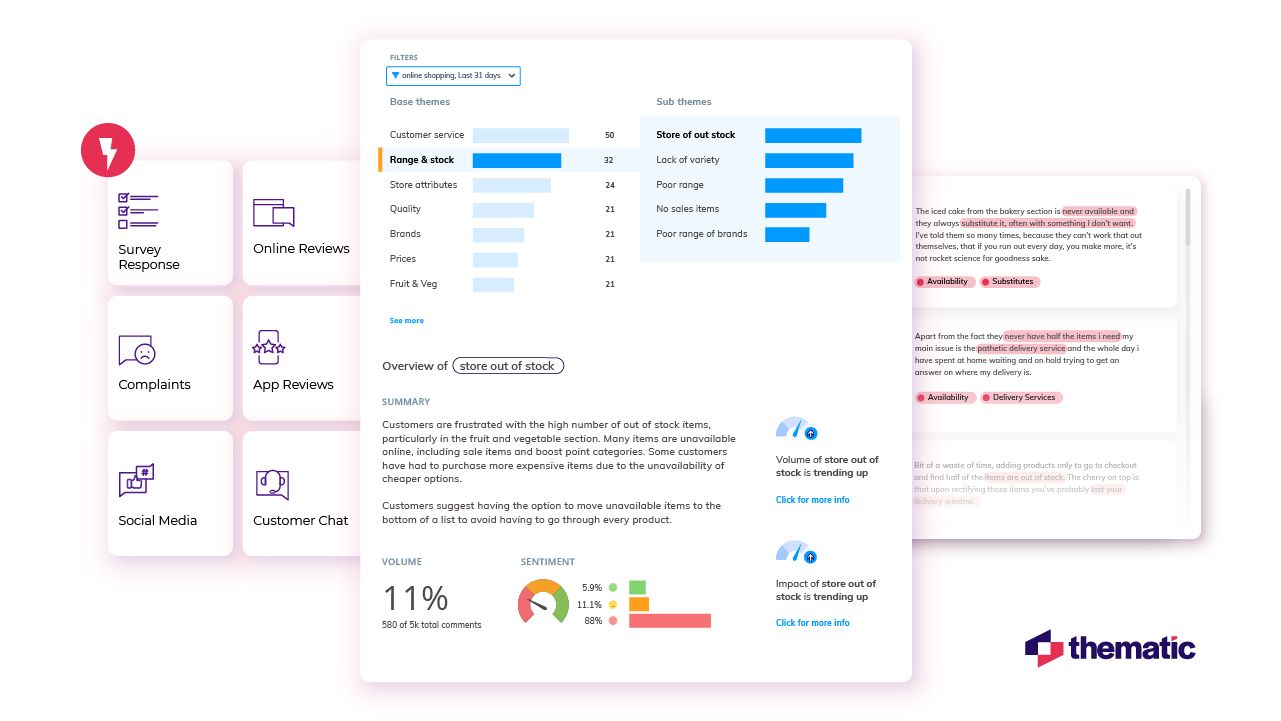
Thematic unifies feedback from multiple sources, then uses AI to automatically discover themes and sub-themes, quantify their impact on scores like NPS, and surface verbatim examples.
Each theme is then linked to your NPS score through impact analysis, which shows exactly how many points each theme is adding or costing. The Scoring Agent can also generate custom metrics directly from verbatim text, measuring things like perceived trust or churn risk signals without needing additional survey questions.
When your NPS changes quarter over quarter, the score change waterfall breaks down the exact drivers. Instead of reporting "NPS dropped 3 points," your team reports "shipping delays cost 5 points, product quality cost 2 points, and support improvements gained 4 points."
Orion Air used this approach to identify that baggage handling issues, despite not being the most frequently mentioned theme, had a disproportionate impact on their NPS. Targeted operational improvements contributed to a 13% overall NPS increase.
Ready to see how Thematic turns NPS verbatims into prioritized action? Book a demo to see your own feedback data analyzed.
Frequently asked questions
What’s the difference between NPS verbatim analysis and sentiment analysis?
Sentiment analysis tells you whether feedback is positive, negative, or neutral. Verbatim analysis goes deeper. It identifies what customers are talking about (themes) and quantifies the impact of each theme on your NPS. Sentiment alone can’t tell you what to fix first.
Can I analyze NPS verbatims with my existing survey platform?
Most survey platforms offer basic text analytics, but they typically require you to define categories manually and don’t quantify theme-level impact on NPS. For teams evaluating which customer feedback analytics tool is best for analyzing NPS verbatims specifically, a customer intelligence platform like Thematic can work alongside your existing survey tool to handle the deeper analysis.
How many NPS responses do I need for meaningful verbatim analysis?
AI-powered customer intelligence tools like Thematic can start surfacing useful patterns with as few as a few hundred responses. The analysis becomes more statistically reliable as volume increases. For enterprise programs processing thousands of responses, automated analysis is often the only practical approach.
How does NPS verbatim analysis fit into a best-of-breed CX tech stack?
In a best-of-breed stack, your survey platform handles collection, your customer intelligence layer (like Thematic) handles analysis, and your BI tools handle visualization. This approach lets you use each tool for what it does best rather than relying on one platform to do everything.
Share
Link Copied!
Request a demo of Thematic's Customer Intelligence Platform
Thematic turns fragmented feedback into one consistent source of customer truth — so every team acts on the same customer story. Up and running in days, not quarters.
Thank you! Your submission has been received!
Oops! Something went wrong while submitting the form.