Lenses: The missing context layer for modern customer intelligence
Enterprises aren't short on customer feedback. They're short on alignment. Lenses by Thematic unify feedback into a shared customer truth while giving every team a tailored view for the decisions they own.
Most organizations struggle with either a single unwieldy taxonomy or fragmented team-specific ones, both of which slow down decision-making
Lenses solve this by creating a main company Lens (your shared customer truth across all channels) alongside tailored team or use-case Lenses shaped to each function's decisions
Thematic automatically builds a two-level theme taxonomy from your data, with no manual rules required, and links new channels as you add them
Teams like Support, Product, Marketing, and Ops each get a decision-ready view without losing consistency with the broader organization
For enterprises running a best-of-breed CX stack, Lenses remove the usual trade-off between specialized tooling and a fragmented customer story, so both humans and AI agents can operate from the same trusted foundation
Built-in governance (auditability, permissions, sharing controls) ensures insights stay trustworthy and explainable as they scale across teams and CX Agents
Enterprises aren’t short on customer feedback. They’re short on alignment.
As we automate more and more tasks in Agentic CX, alignment is a key prerequisite.
Support hears one story in tickets. Product hears another in app reviews. Marketing sees something else in social and surveys. Each team has their own dashboard, their own taxonomy, and increasingly, their own ad-hoc AI prompts.
The result is predictable: fragmented truths, duplicated analysis, time spent on consolidation across datasets. As a result, decisions move slowly, or worse, in different directions.
Most organizations try to solve this with one of two approaches:
1. A single company-wide taxonomy It sounds tidy, but it quickly becomes unwieldy. To serve everyone, it becomes too broad. To be useful, it becomes too complex. Either way, it’s not detailed enough for real decisions.
2. Separate taxonomies for each dataset or tool This creates local usefulness but global fragmentation. Teams optimize for their own view, then struggle to reconcile insights across channels, regions, and functions.
Customer intelligence fails when the business can’t agree on what’s true, let alone what to do next.
At Thematic, we built Lenses to close that gap: a way to unify feedback into a shared customer truth, while still giving every team a tailored view that fits the decisions they own. Lenses provide the governed context and guardrails that both teams and CX Agents rely on, so insights are consistent, explainable, and ready for action.
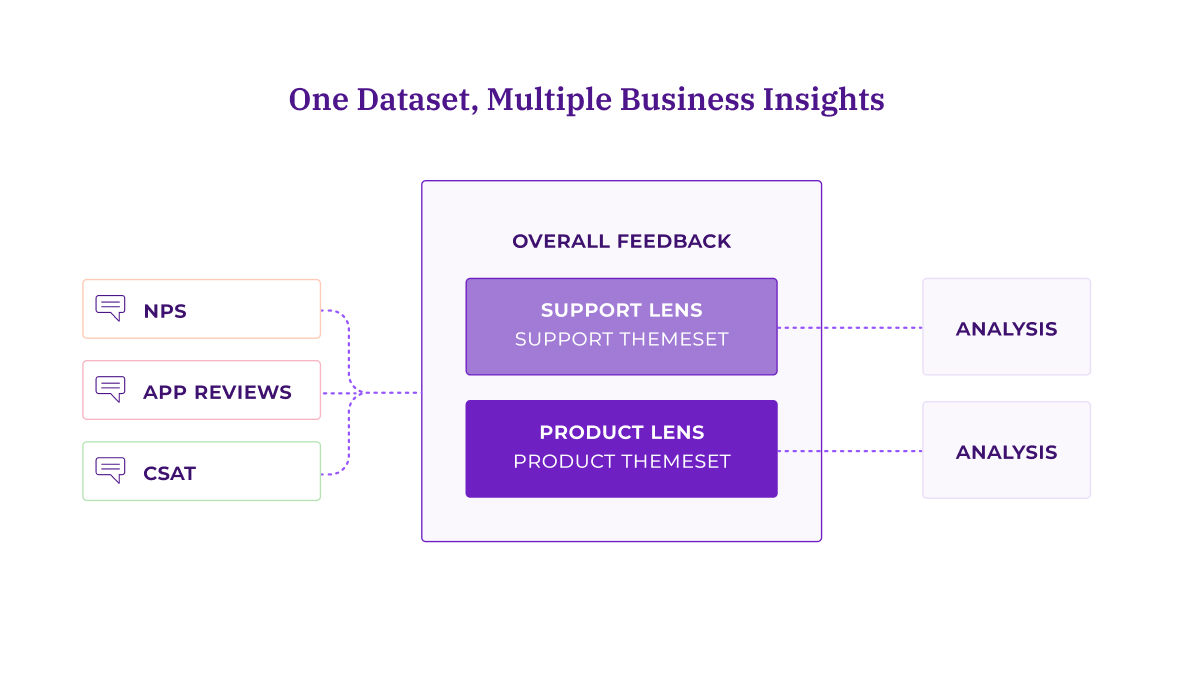
One dataset, multiple business insights: Lenses let teams like Support and Product each get tailored views from the same unified feedback.
What are Lenses?
A Lens is a curated, governed view of customer feedback that enables consistent analysis across channels. For CX Agents, Lenses provide the operating context and guardrails. That said, we are not forcing every team into the same one-size-fits-all structure.
Lenses are designed to supportboth:
A main company Lens that unifies feedback from every channel into one comprehensive, reliable set of themes. This is your shared “customer truth.”
Team or use-case Lenses that tailor themes and how they are grouped to serve a purpose, across datasets.. Each function can act on what matters to them.
Think of it like a modern operating system for customer insight (and the CX Agents that power them):
One core truth that stays consistent across the business
Multiple decision-ready views that help each team move faster
What Lenses unlock that traditional approaches can’t
1. Shared truth across channels, without flattening nuance
Lenses unify feedback across conversations, reviews, surveys, tickets, calls, and complaints. You can stop arguing about whether a trend is “real” or just a channel artifact. Context stays intact: channel, product line, region, customer segment, journey stage. Insights stay actionable.
2. Decision-ready views for every team, without fragmentation
Each team gets the same underlying customer truth, shaped to their decisions: Support (repeat contacts), Product (release regressions), Marketing (brand trust), Ops (process friction). You can also spin up a Lens for ad-hoc questions (e.g., “outages” across datasets) without creating a new taxonomy that drifts over time.
3. Governance that makes agents and people trustworthy at scale
Scaling insight across teams requires more than “sharing a dashboard.” It requires confidence that:
the analysis is consistent
the definitions are known
the outputs are explainable
access is controlled
Lenses are built for CX and Insights leaders who need visibility and control, without becoming a bottleneck.
How Lenses work in Thematic: unify → tailor → govern
Lenses are designed to be practical, not theoretical:
1. Unify: create a shared customer truth
Start with a main company Lens that represents how your organization wants to understand customer feedback at the highest level. Include all channels accessible to you.
Thematic automatically creates a two-level taxonomy of themes and subthemes from this data. No need to create rules or tell the AI what to look for. For each theme, Thematic will explain what evidence it used to create it, and which dataset it comes from.
If you add a channel later, Thematic will link existing themes to this lens, and will add new themes if required.
This lens becomes your anchor: a consistent thematic structure that leadership can trust and teams can rally around.
When analyzing data, you can see how often a theme appears in which dataset, so that you get an idea which issue is operational and which one is a brand issue.
2. Tailor: create team and use-case Lenses
At any time, you can create specific Lenses for:
specific teams (Support, Product, Marketing, Ops)
specific programs (onboarding, delivery, returns, payments)
specific tasks (root-cause analysis, release monitoring, complaint analysis)
Simply describe in your own words what’s important to include and Thematic’s AI will automatically tailor the discovered themes and how they are organized.
Again, you can toggle which datasets you want to use when creating the lens, and you can add datasets after the fact.
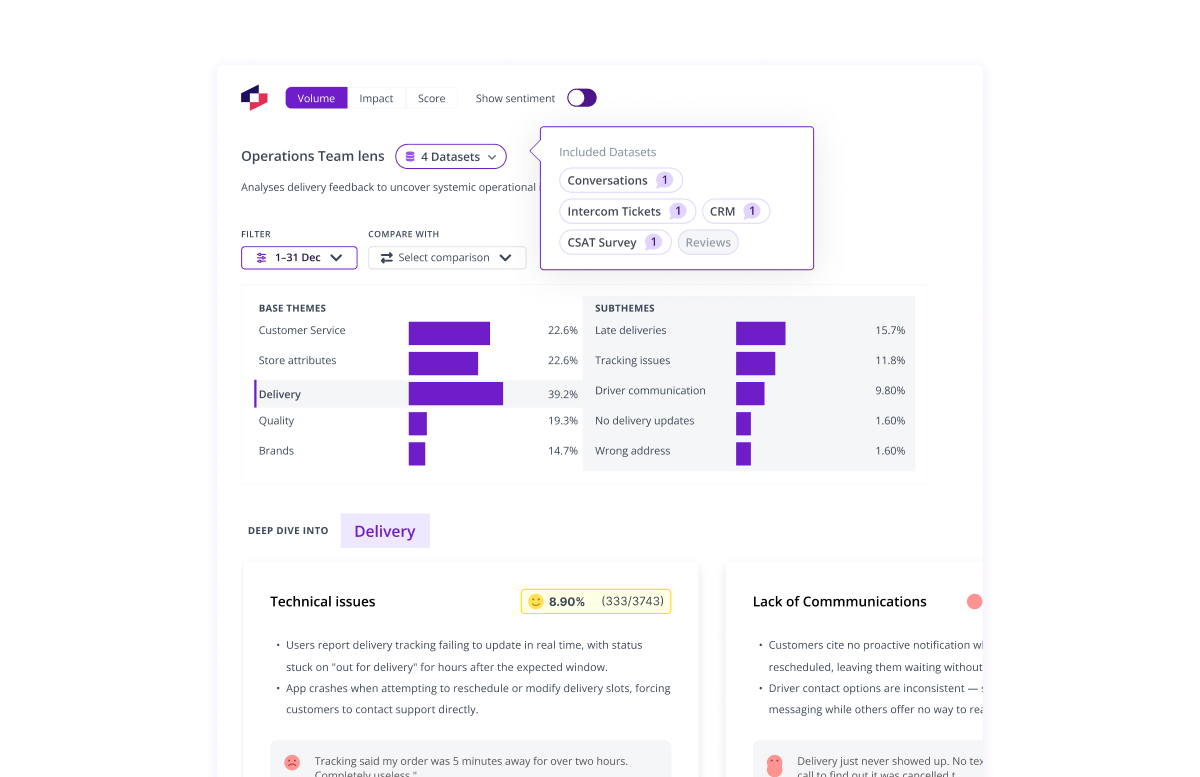
An Operations Team Lens in Thematic, showing delivery as the top theme at 39.2% with subthemes like late deliveries, tracking issues, and driver communication.
3. Govern: keep the customer story consistent as it scales
As Lenses spread across the organization, governance matters more, not less.
Lenses support the controls CX/Insights leaders need:
auditability and transparency into how insights are produced
permissions and sharing controls by stakeholder group
the ability to guide and govern how feedback is interpreted and distributed
In other words: scale without losing trust.
What makes Lenses powerful
One complete customer Lens across channels Unify conversations, reviews, surveys, tickets, calls, and complaints into a single truth.
Tailored decision-ready Lenses Support sees contact drivers and resolution gaps; Marketing sees value perceptions and brand risks; Product sees feature and release feedback.
Robust cross-channel analysis Thematic manages integrations and best practices for aligning complex datasets.
Governance by design Audit and permission controls help you confidently share insights across stakeholders. And ensure that teams and CX Agents operate from the same trusted definitions.
Trust and governance: not another black box
Most teams don’t need “more AI.” They need AI they can trust in production.
That’s why Lenses are built around the same principles for Agentic CX in Thematic: transparency, human-in-the-loop control, and optional rigor when needed
Lenses make customer intelligence:
explainable (why is this showing up?)
consistent (does it mean the same thing across channels?)
governed (who can see what—and why?)
useful (can a team act on it today?)
The new default: alignment before activation
The best organizations don’t just “listen.” They make customer truth usable across the business.
Because once you have alignment, everything else becomes easier:
Theming Agents create Lenses that are tailored and useful
Scoring Agents create measurements that are credible and adopted
Actions Agents trigger actions that are easier to route and operationalize
CX and Insights shift from reporting to orchestrating impact
Lenses are the layer that turns customer feedback into a shared operating model for decision-making.
Request a demo of Thematic's Customer Intelligence Platform
Thematic turns fragmented feedback into one consistent source of customer truth — so every team acts on the same customer story. Up and running in days, not quarters.
Thank you! Your submission has been received!
Oops! Something went wrong while submitting the form.