How to Evaluate Multi-Channel Integration in Feedback Analytics Platforms
Dozens of platforms claim to unify your customer feedback, but their integration capabilities vary widely. This guide provides a framework for evaluating multi-channel integration, comparing platforms, and building an ROI case before you buy.
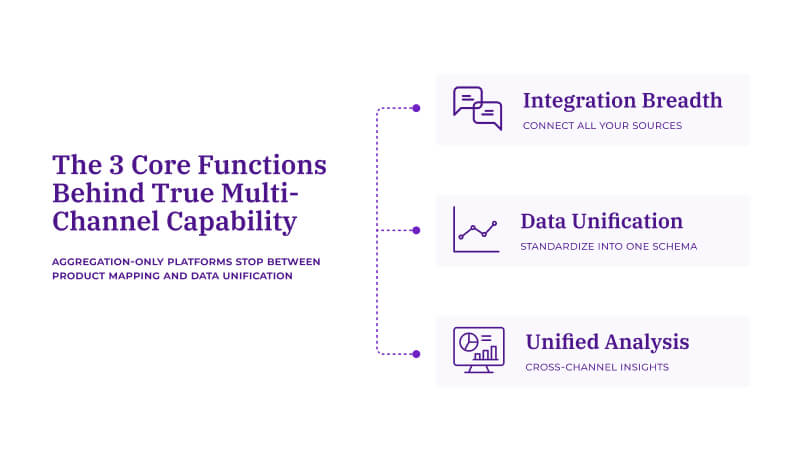
True multi-channel integration requires three core functions: broad connector coverage, automatic data unification, and unified cross-channel analysis.
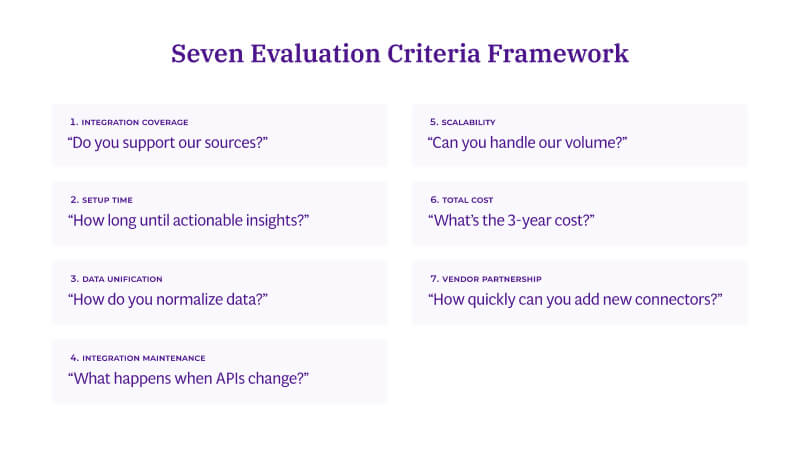
Use the seven-criteria framework (coverage, setup time, unification, maintenance, scalability, cost, vendor partnership) to compare platforms, and always test with your real data before committing.
AI-powered customer feedback analytics platforms like Thematic automatically discover themes in hours (not weeks), adapt as new feedback arrives, and let you refine results yourself. No specialist required.
Choosing the right customer feedback analytics software can feel overwhelming. Dozens of platforms claim to unify your customer data, but their integration capabilities vary widely in practice.
The difference between a good choice and a poor one often comes down to three factors:
How well the platform integrates with your existing feedback sources
Whether the analysis actually helps you make decisions
This guide provides a framework for evaluating multi-channel integration capabilities, comparing platforms, and building an ROI case before you buy.
What makes integration truly "multi-channel"
Multi-channel integration connects a feedback analytics platform to multiple data sources and analyzes them as a unified dataset. True multi-channel capability requires three core functions:
Integration breadth: Native connectors for surveys (Qualtrics, SurveyMonkey), support systems (Zendesk, Intercom), review platforms (App Store, Google Play, Trustpilot), and data warehouses (Snowflake, BigQuery).
Data unification: Automatic standardization of different data formats into a consistent schema, while preserving source-specific metadata.
Unified analysis: A single analytical framework that works across all sources, enabling cross-channel comparison and pattern discovery.
Many platforms claim multi-channel support but only aggregate data without enabling unified analysis.
This distinction matters more than it might seem: aggregation shows you feedback from multiple places, while true integration reveals patterns across channels you couldn't see by analyzing each source independently.
The table below show as side-by-side comparison of aggregation versus true integration.
Evaluation criteria framework
When comparing feedback analytics platforms for their multi-channel integration capabilities, these seven criteria will help you make a well-informed decision.
Criteria
What to evaluate
Key question to ask
Integration coverage
Native connectors, API options, data warehouse support
"Do you support our current feedback sources?"
Setup time
Self-service vs. consultant-dependent implementation
"How long until we have actionable insights from our data?"
Volume capacity across integrations, processing speed, multi-dataset handling
"Can you handle our current volume across all channels and future growth?"
Total cost of integration
Connector fees, API costs, implementation services, ongoing maintenance
"What's the three-year total cost for integrating all our sources?"
Vendor partnership
Support model, connector roadmap, new integration requests
"How quickly can you add a new connector we need?"
Integration coverage
Start by counting the native connectors available and assessing their quality.
Does the platform support your current feedback sources? Consider survey tools, support systems, review platforms, social channels, and internal databases.
How quickly can new sources be added? Native connectors typically take hours to configure, while API integrations take days to weeks.
Can the platform connect to your data warehouse? This becomes especially important for organizations with centralized data infrastructure.
Setup time and technical requirements
Next, evaluate how quickly you can get from signed contract to actionable insights. Implementation timelines generally fall into three categories:
Self-service setup (hours to days): You can configure integrations without IT involvement. Look for OAuth-based authentication and pre-built field mapping.
Assisted setup (days to weeks): The vendor provides onboarding support for complex configurations. This is reasonable for enterprise deployments.
Consultant-dependent setup (weeks to months): This requires professional services for initial configuration. It's common with enterprise CX platforms, but adds cost and delays time to value.
What to ask vendors: "How long from contract signing until we have actionable insights from our own data?" You'll find that answers vary dramatically, from days to months depending on the platform.
Data unification capabilities
How a platform handles data from different sources determines whether you get truly unified insights or just a collection of separate analyses.
Schema standardization: Does the platform automatically map fields from different sources into a consistent structure? Manual mapping adds setup time and maintenance burden.
Metadata preservation: Can you still identify which channel feedback came from after unification? This enables channel-specific analysis alongside cross-channel insights.
Cross-channel customer matching: Can the platform link feedback from the same customer across different channels? This creates a complete picture of individual customer journeys.
Integration maintenance
Integrations require ongoing attention. Evaluate how much maintenance burden falls on your team.
Connector updates: When source platforms update their APIs, who handles the changes — you or the vendor?
Error handling: How does the platform alert you to sync failures? How easily can you troubleshoot and resolve issues?
Sync reliability: What's the uptime guarantee for integrations? How quickly does new feedback appear on the platform?
Scalability across integrations
Assess whether the platform can handle your current volume and future growth across all connected sources.
Volume capacity: Can it process tens of thousands of feedback items monthly from multiple sources without performance degradation?
Speed: How quickly does new feedback appear in dashboards? Real-time or near-real-time updates enable faster response to emerging issues.
Multi-dataset handling: Can you analyze multiple data sources simultaneously, or must each be processed separately?
Total cost of integration
Calculate the full investment for integrating all your feedback sources over three years.
Native connector fees: Some platforms charge per connector or tier pricing based on integration count.
API and custom integration costs: Building custom integrations requires developer time and ongoing maintenance.
Implementation services: Professional services fees for configuring complex integrations.
Ongoing maintenance: Internal resource time for managing integrations, troubleshooting sync issues, and handling source changes.
Hidden costs: Many enterprise platforms charge separately for data warehouse connections, premium connectors, or API access. Ask about these upfront.
Vendor partnership for integrations
Finally, evaluate the vendor's responsiveness to your integration needs.
Support model: How quickly can you get help when an integration breaks? Is there dedicated support for integration issues?
Connector roadmap: Does the vendor regularly add new native connectors? How do they prioritize which sources to support?
Custom integration requests: How quickly can the vendor add a connector you need? Enterprise vendors often take months, while more agile vendors can respond in weeks.
Why analysis approach matters for integrated feedback
The analysis approach a platform uses directly affects how quickly you get value and how actionable your insights will be.
Taxonomy-based platforms (like Medallia and Qualtrics XM Discover) require you to build topic models using pre-defined industry taxonomies or category structures, often augmented by machine learning. Setup typically takes weeks to months, and changes often require specialist involvement.
This approach works well for predictable feedback patterns within established categories, but can require ongoing maintenance to capture emerging themes that fall outside existing taxonomies.
AI-powered feedback analytics platforms like Thematic automatically identify themes from your data without pre-defined categories. Setup takes hours to days, and you can make changes yourself through human-in-the-loop refinement. This approach discovers unexpected themes and adapts as new feedback arrives, while still giving you control over the final taxonomy.
💡The key question to ask yourself:
Do you want to define what to look for upfront, or discover what's actually in your data?
How feedback analytics platforms compare on integration
Factor
Thematic
Medallia
Qualtrics XM Discover
Setup time
Hours to days
Weeks to months
4 weeks to 6 months
Making changes
Self-service
Typically requires specialist
Typically requires specialist
Theme discovery
Automatic, bottom-up from your data
Rule-based foundation with ML augmentation*
Rule-based taxonomies with AI enrichment*
Emerging themes
Alerts you automatically
Requires taxonomy maintenance
Requires taxonomy maintenance
*Both Medallia and Qualtrics incorporate machine learning and AI into their text analytics. Medallia uses their Athena AI platform, while Qualtrics offers AI-assisted topic modeling in XM Discover.
However, both platforms still rely on pre-defined taxonomies and category structures as their foundation, requiring initial configuration and ongoing maintenance. Thematic's bottom-up discovery approach automatically identifies themes from your data without pre-built category models.
Thematic's approach to analyzing feedback from multiple different sources
Thematic combines broad integration coverage with AI-powered analysis, addressing all three core functions of multi-channel integration:
Integration: Native connectors for major survey, support, review, and CX platforms. You can also import data via API, sFTP, or file upload for maximum flexibility. Connect new data sources and start analyzing within hours, not months.
Unification: Automatic data standardization that preserves source-specific metadata while enabling cross-channel analysis.
Analysis: Bottom-up theme discovery finds patterns in your data without requiring pre-built taxonomies. Every theme traces back to specific customer comments, so you can verify and defend your insights to stakeholders.
Accessibility: The Theme Editor lets analysts refine AI-discovered themes without vendor dependency. Thematic Answers lets anyone ask questions and get instant, verifiable analysis.
💡Pro tip
Use Thematic's multi-channel analysis capabilities to spot emerging trends and prioritize improvements based on the feedback that matters most. Combining insights from multiple sources gives you a complete picture of the customer experience, helping you make data-driven decisions that deliver real results.
ROI calculation for multi-channel integration in feedback analytics platforms
Building a solid business case helps ensure you get buy-in for your investment. When evaluating the ROI of integration capabilities specifically, consider these factors:
Integration cost savings
Calculate the cost difference between integration approaches:
Native connectors vs. custom builds: Custom API integrations require significant developer time to build and maintain. Native connectors eliminate this cost entirely.
Self-service vs. consultant-dependent setup: Enterprise platforms often require substantial professional services investment for initial integration configuration. Self-service platforms reduce this to internal resource time only.
Maintenance burden: API changes, sync failures, and schema updates require ongoing attention. Native connectors maintained by the vendor reduce this burden significantly.
Value of unified data
Quantify the business benefits of having integrated feedback sources:
Faster issue detection: Cross-channel visibility surfaces problems that single-source analysis misses. Calculate the cost of issues that went undetected due to siloed data.
Reduced duplicate analysis: Without integration, teams often analyze the same feedback separately. Calculate analyst hours saved by eliminating redundant work.
Cross-channel insights: Some patterns only emerge when you can see the same customer's feedback across touchpoints. Estimate the value of insights impossible to find in single-source analysis.
For a comprehensive walkthrough for connecting NPS to revenue and customer acquisition costs, including downloadable spreadsheets, explore our ROI of CX guide.
Common integration evaluation mistakes to avoid
Even experienced buyers can fall into these traps when evaluating multi-channel integration capabilities:
Mistake 1: Prioritizing connector count over connector quality
A platform with many connectors that require manual configuration delivers less value than one with fewer, well-designed connectors that work immediately.
Ask vendors: "How much configuration is required for each connector?"
Mistake 2: Underestimating integration setup time
Vendors often quote "implementation timelines" that exclude the time required to configure field mappings, test data flows, and resolve sync issues.
Be specific when asking: "How long from contract signing until we have data flowing from all our sources?"
Mistake 3: Overlooking data unification complexity
Connecting to multiple sources is only half the challenge. Ask how the platform normalizes data from different formats and whether you can analyze across channels or only within individual sources.
Mistake 4: Testing integrations with sample data only
Platforms perform differently with curated demo data versus your actual feedback sources. Always request a trial that connects to your real systems before committing.
Mistake 5: Forgetting about integration maintenance costs
Initial license fees often exclude connector fees, API costs, and the internal resources needed to maintain integrations when source systems change. Calculate three-year total cost of integration, not just Year 1 subscription fees.
Multi-channel integration evaluation checklist
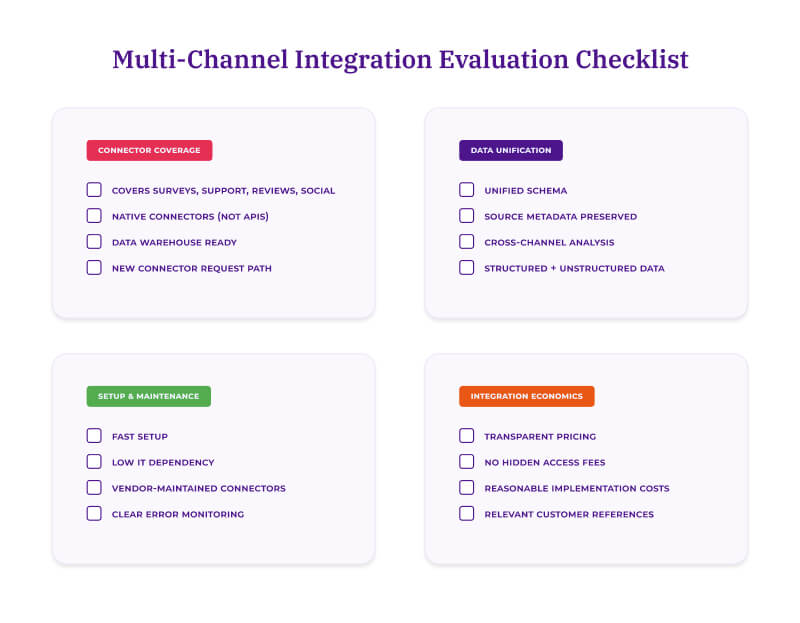
Before making your final decision on a feedback analytics platform's integration capabilities, confirm the following:
Connector coverage
Supports your current feedback sources (surveys, support, reviews, social)
Offers native connectors (not just APIs) for major platforms
Connects to your data warehouse if applicable
Has a clear process for requesting new connectors
Data unification
Normalizes data from different sources into a consistent schema
Preserves source-specific metadata for channel-level analysis
Enables cross-channel analysis, not just aggregation
Handles both structured and unstructured feedback
Setup and maintenance
Integration setup timeline fits your needs (days vs. months)
Connectors can be configured without IT involvement (or IT dependency is acceptable)
Vendor maintains connectors when source APIs change
Clear error handling and sync monitoring
Integration economics
Transparent connector pricing with no hidden fees
No additional charges for data warehouse connections or API access
Request a demo of Thematic's Customer Intelligence Platform
Thematic turns fragmented feedback into one consistent source of customer truth — so every team acts on the same customer story. Up and running in days, not quarters.
Thank you! Your submission has been received!
Oops! Something went wrong while submitting the form.