Munna Ahaduzzaman, Lead Software Engineer at Atlassian, once summed up the problem every enterprise feedback program hits: "If you have a star rating from one product and a feedback form from another saying you are happy, angry or sad, how do you quantify the overall result? The problem in any company is, since we have so many insights and so many different types of data, how do you aggregate the insights to gain clear direction from them?" Surveys, support tickets, app reviews, call notes, and social mentions each tell a partial story. Leadership gets a different answer depending on which team they ask.
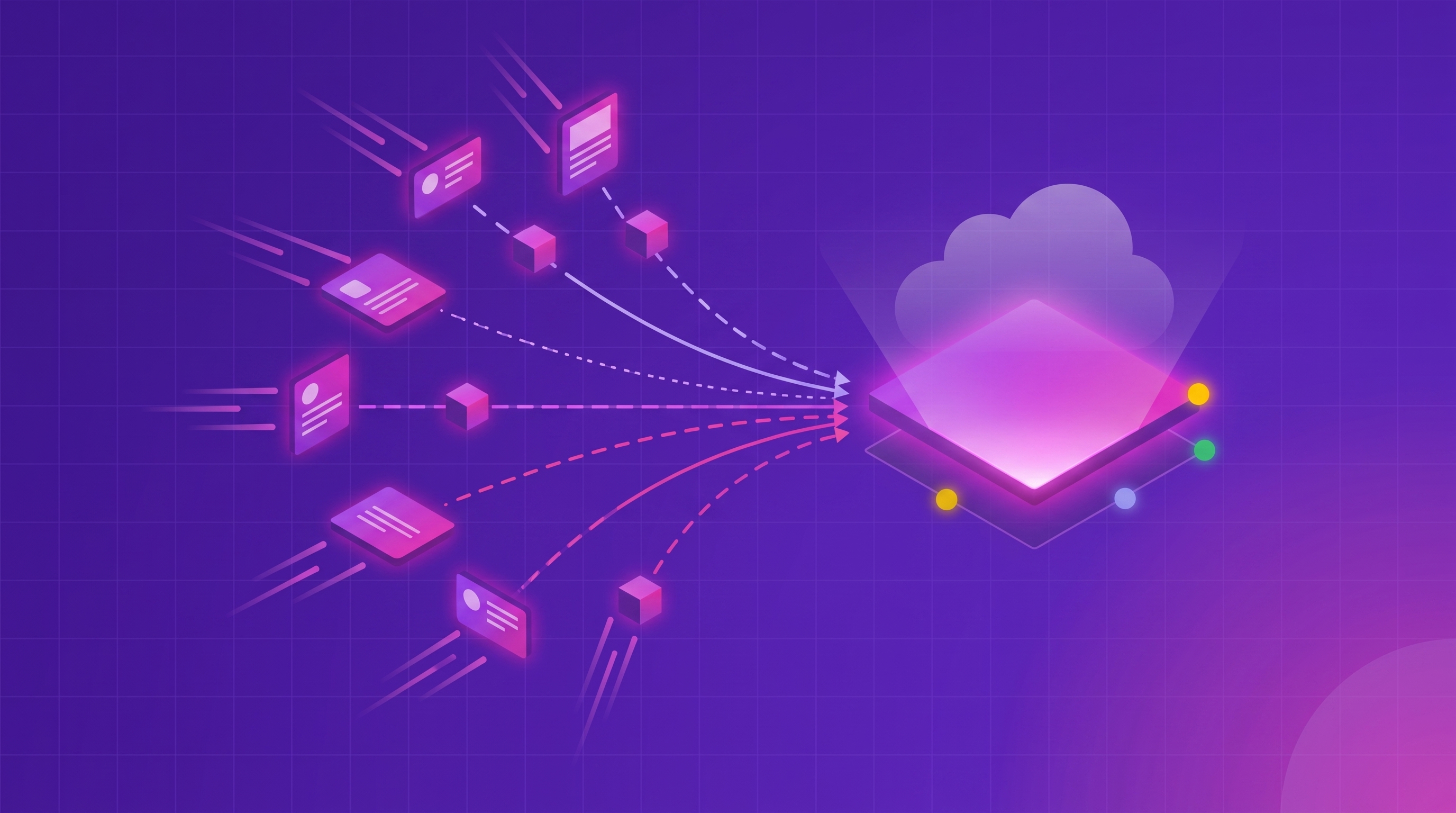
Creating a single source of truth for customer feedback data takes five steps. Decide which layer is authoritative. Connect every feedback source and normalize the records. Resolve customer identity and keep the duplicates. Build one theme taxonomy that spans every channel. Then make every theme traceable back to the raw comments behind it. Thematic is built as this layer: it unifies feedback from every channel into one set of themes, with every conclusion traceable to the source comments, so every team reads from the same customer truth.
This guide walks through each step, the architecture decisions inside them, and a worked example from Atlassian.
The five-step build
- Decide where the truth lives: separate systems of record from the source of truth.
- Connect every source and normalize the records into one schema.
- Resolve customer identity and keep the duplicates instead of deleting them.
- Build one theme taxonomy that holds across every channel.
- Make every theme traceable back to the raw comments behind it.
Step 1: Decide where the truth lives
A survey platform, a ticketing system, and an app store are systems of record: places where feedback originates and is stored. A source of truth is different. It is the one authoritative layer everyone reads from when they ask "what are customers telling us?" Confusing the two is why consolidation projects stall: teams try to crown one system of record as the truth, and every other channel's data gets left out.
The practical move is to designate a dedicated analysis layer that sits above the collection tools. The collection tools keep doing their jobs. The analysis layer ingests from all of them and becomes the only place insights are produced. This is the aggregation versus true integration distinction: aggregation shows you feedback from multiple places, while true integration reveals patterns across channels.
The scale of the problem is why this step comes first. MuleSoft's Connectivity Benchmark found enterprises run an average of 897 applications, with only about 29 percent of them integrated. Feedback tools are no exception.
Step 2: Connect every source and normalize the records
With the authoritative layer chosen, connect the sources. There are four common integration methods: native connectors, APIs, file imports, and data warehouse connections. Each incoming record should normalize to a common schema: the verbatim text, a timestamp, the channel, the customer or account identifier, and any scores or metadata the channel carries.
Normalization is where quality problems surface, and they are expensive to ignore. Gartner puts the average cost of poor data quality at $12.9 million per year. Catching malformed timestamps, empty verbatims, and mislabeled channels at ingestion is far cheaper than discovering them in an executive report.
LendingTree, an online marketplace for loans, runs this pattern at scale: feedback and attributes flow in from 10 continuous data sources covering 7 product verticals, more than 20,000 comments in a 90 day period, analyzed in Thematic without manual coding.
Step 3: Resolve customer identity and keep the duplicates
The same customer appears in your survey tool as an email address, in your ticketing system as a ticket requester, and in an app store as a screen name. Identity resolution means linking feedback records to a shared customer or account key wherever one exists, so you can ask questions like "what do our enterprise accounts complain about?" across every channel at once. Where no key exists (anonymous app reviews, for example), the record still joins the truth layer; it just carries channel-level context instead of account-level context.
Deduplication is the counterintuitive part. When the same complaint arrives as a support ticket, a survey verbatim, and a one-star review, the instinct is to collapse them into one record. Don't. A complaint that shows up through three channels is a severity signal, not a data error. The right pattern is to link related records so they count once per customer in frequency metrics but retain each occurrence as evidence of intensity.
Step 4: Build one theme taxonomy that spans every channel
This is the step that separates a feedback warehouse from a source of truth. If your support team tags tickets with one vocabulary, your research team codes surveys with another, and your app reviews go untagged, you have three private languages and no shared one. Cross-channel questions become unanswerable, and every team develops its own version of the customer story.
The taxonomy has to be built from the feedback itself, bottom-up, and applied consistently across every channel. Thematic's approach is to discover themes from the combined data and hold them in one taxonomy, so "delivery delays" means the same thing whether the signal came from a ticket or a survey. Atom Bank, a digital-first UK challenger bank, applied exactly this pattern. The team unified omnichannel data across 7 feedback channels and 3 product lines and standardized the analysis in Thematic. That eliminated duplicated analysis effort, removed data silos, and built a central insights system to prioritize customer experience improvements. The downstream results included a 69 percent reduction in calls related to unaccepted mortgage requests and 110 percent growth in the customer base.
One taxonomy does not mean one view. Different teams can look at the same shared truth through their own lens, filtered to the themes and segments they act on, without forking the underlying data.
Step 5: Make every theme traceable to the raw comments
A single source of truth is only useful if people trust it, and trust comes from lineage. Every theme should trace back to the specific customer comments that created it, and every comment should trace back to its source record and channel. When a skeptical executive challenges a finding, the answer is not "the model says so." The answer is the actual customer comments, two clicks away.
Traceability is also what keeps the truth layer honest over time. When customers change how they talk, you can see which comments stopped fitting the taxonomy and adjust deliberately instead of drifting silently.
The payoff of the whole build is consistency. Salesforce's State of the Connected Customer research found 79 percent of customers expect consistent interactions across departments, while 55 percent say it feels like communicating with separate departments. Companies cannot act consistently on customer feedback they read inconsistently.
A worked example: how Atlassian built its feedback source of truth
Atlassian sells team collaboration software, including Jira, Confluence, and Trello. The company receives an estimated 60,000 pieces of customer feedback every month, with users sharing thoughts across Jira, Confluence, Trello, support chats, Reddit, and more. Before consolidating, many of those channels were analyzed in isolation.
The team built a pipeline with Thematic as the analysis layer. The design goal was data consistency: no matter the channel, feedback was structured, deduplicated, and aligned to the same taxonomy. The analyzed data, including over 1 million community questions and comments, flows into a central dashboard where the whole company can explore what customers are saying. Adding a new feedback source no longer means custom engineering each time. As Ahaduzzaman put it: "We built a platform that means it is now easier to add new kinds of feedback data, we don't have to write another integration every time."
The outcomes followed the architecture. Issue resolution times dropped by 50 percent, and email open rates hit 26 percent, more than double the average. Mick Stapleton, Atlassian's Lead Analyst for Feedback, describes the result: "Thematic enables us to manage complexity across channels quickly, so now we have cross-channel insights feeding teams across the business and to send more personalized responses to users across the company."
Common mistakes to avoid
- Crowning a collection tool as the truth. Your survey platform is a system of record. Making it the source of truth silently excludes every other channel.
- Deleting duplicates. Cross-channel repetition is a severity signal. Link related records; never discard them.
- Letting each team keep its own tags. Per-channel taxonomies diverge silently until no cross-channel question can be answered. One taxonomy, many views.
- Skipping lineage. If a theme cannot be traced to raw comments, the first executive challenge it fails will discredit the whole layer.
- Treating the build as one-and-done. Feedback language shifts and new channels appear. Budget for taxonomy governance, not just ingestion.
- Boiling the ocean on day one. DoorDash, the largest online food delivery company in the US, consolidates and synthesizes feedback from tens of thousands of open-ended NPS survey responses from Consumers, Dashers, and Merchants. As Zach Schendel, DoorDash's Head of Research, puts it: "It's impossible for me, or anyone else, to find anything useful from that information unless it's tamed in some kind of way." Start with the channels that carry the most signal, prove the layer works, then expand.