Why AI-Powered Customer Feedback Analytics Matters for Multi-Channel Data
AI-powered customer feedback analytics transforms multi-channel data into actionable insights. Discover themes automatically and quantify what moves metrics.
Build, Buy or Partner? A Layered Guide to AI Feedback Analytics
Guide for businesses in deciding how to implement AI for customer feedback analysis, moving beyond a simple "build or buy" choice to a layered approach
Customer feedback analytics software transforms unified feedback into actionable intelligence. It automatically:
finds patterns you'd miss,
quantifies what actually moves your metrics, and
delivers insights in hours with 80%+ accuracy.
Thematic discovers themes from multi-channel feedback using transparent AI, giving CX and Insights teams defensible insights they can present to executives with confidence.
But unified data doesn't automatically mean unified insights.
Melodics ran into exactly this problem. Their small team needed to distinguish between "loud feedback" and "impactful feedback" across multiple channels. Manual analysis took days and covered only a fraction of responses.
AI-powered theme discovery revealed which feedback actually drove user behavior versus which just generated the most complaints.
Unified data was their starting point. Customer feedback analytics was what turned that data into decisions.
Customer feedback analytics software transforms feedback from multiple channels into actionable intelligence by automatically:
discovering themes you wouldn't think to look for,
quantifying which issues actually affect your metrics, and
delivering insights in hours instead of weeks.
This guide explains:
how AI-powered customer feedback analysis differs from traditional approaches,
what value AI creates from unified data, and
how to evaluate AI capabilities when choosing platforms.
When AI-powered customer feedback analytics matters for multi-channel data
All your feedback sources now flow into one platform. Now, AI-powered analysis is what unlocks that investment.
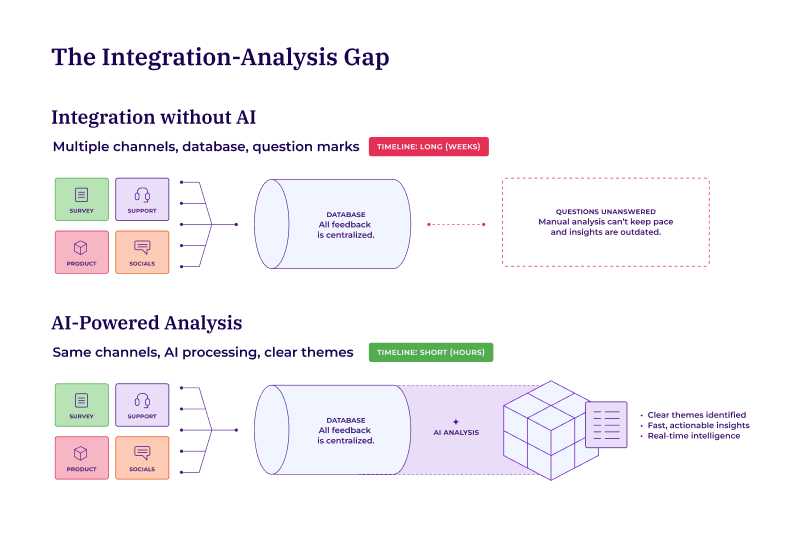
Without it, centralized feedback creates what we call the Integration-Analysis Gap. Manual analysis can't keep pace with multi-channel volume, leaving critical questions unanswered:
By the time analysts finish categorizing feedback, it's already outdated.
Greyhound's customer experience team collected feedback from multiple touchpoints: post-ride surveys, station feedback, driver evaluations, and operational data. Manual analysis took 3 hours to 3 days, but by the time insights reached stakeholders, the data was 3-4 weeks old.
After implementing AI-powered customer feedback analytics, they reduced analysis time tenfold. What once took 3 hours to 3 days now happens in minutes.
Station managers could spot location-specific issues the same day and respond immediately.
More importantly, the AI discovered positive driver sentiment themes they didn't even know to look for. This freed capacity to launch 4 previously backlogged research projects.
The Integration-Analysis Gap: Unified data doesn't automatically mean unified insights. AI-powered analysis bridges the gap between collecting feedback and acting on it.
How AI-powered theme discovery differs from taxonomy-based feedback analysis
Automatic theme discovery finds patterns directly from your feedback data without requiring upfront taxonomy work. Taxonomy-based approaches require you to specify what to look for upfront and maintain those categories over time.
Thematic's automatic theme discovery works within days of connecting your data, no lengthy configuration, no training period, no consultants required.
The AI discovers themes bottom-up from your feedback while giving analysts transparent control to validate and refine results.
Thematic combines traditional text analytics with large language models, selecting the best approach for each task. The platform has been refined over years of real-world feedback analysis and continuously adopts the latest AI models, delivering both the precision of proven methods and the flexibility of modern AI.
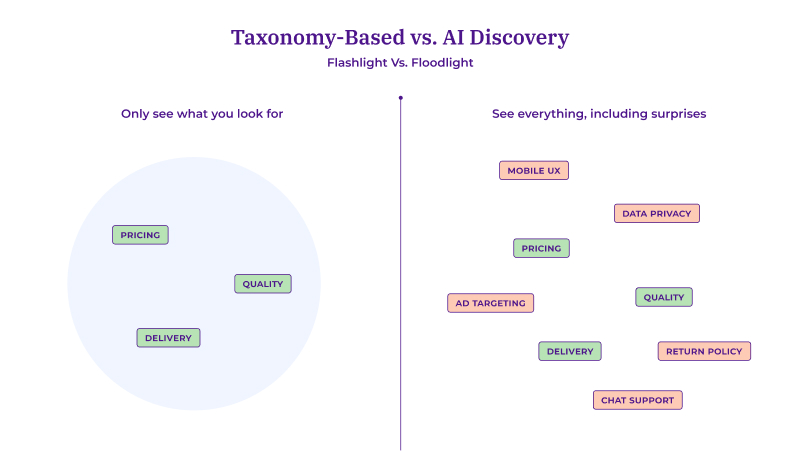
Think of it this way: taxonomy-based analysis is like searching with a flashlight. You only find what you point at. Automatic discovery is like turning on the lights. You see everything, including what you didn't know to look for.
Taxonomy-based analysis only finds what you look for. AI discovery reveals everything—including surprises.
Platforms like Medallia and Qualtrics XM Discover use taxonomy-based analysis. You start by defining categories: product quality, service speed, pricing concerns, staff behavior. The system then classifies feedback into these pre-built buckets.
This approach works well when feedback patterns are predictable. But you need to know what you're looking for before you start. When new themes emerge, you need to update your taxonomy manually or they go undetected.
At a multi-channel scale, taxonomy maintenance becomes a significant burden.
Different channels surface different themes. Products launch. Markets change. Customer expectations shift.
Automatic discovery reveals issues hiding in plain sight
AI-powered feedback analysis platforms like Thematic use a different approach. The AI reads through your feedback and identifies patterns automatically. Themes emerge from the data itself, not from categories you defined in advance.
Melodics discovered this when analyzing feedback across their NPS surveys, in-app questions, and support tickets. Their team expected to find themes about music selection, difficulty levels, and technical issues. Those appeared, as expected.
But the AI also surfaced that app lag had a major impact on their metrics, while features that generated high mention volume (like lesson variety) had surprisingly low impact on scores.
These insights revealed what customers talked about versus what actually affected their satisfaction.
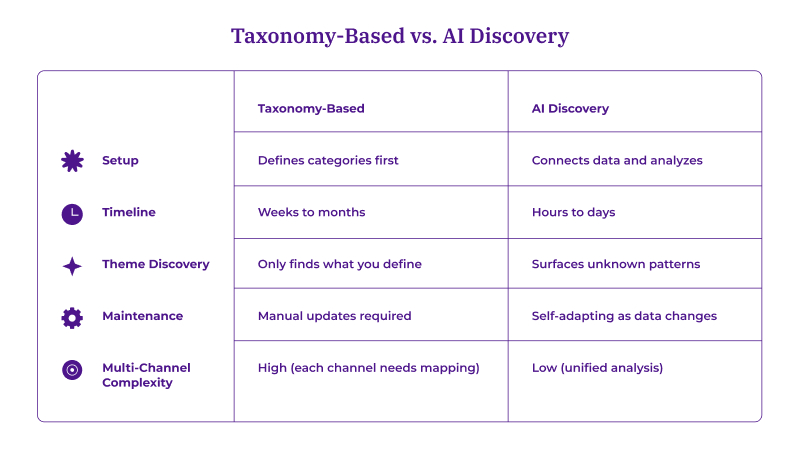
Five key differences between taxonomy-based classification and AI-powered theme discovery.
Why this matters for multi-channel feedback
Multi-channel feedback introduces more complexity than single-source analysis. Each channel surfaces themes in different ways.
Survey respondents use formal language.
Support tickets capture problems mid-crisis.
Reviews reflect post-experience sentiment.
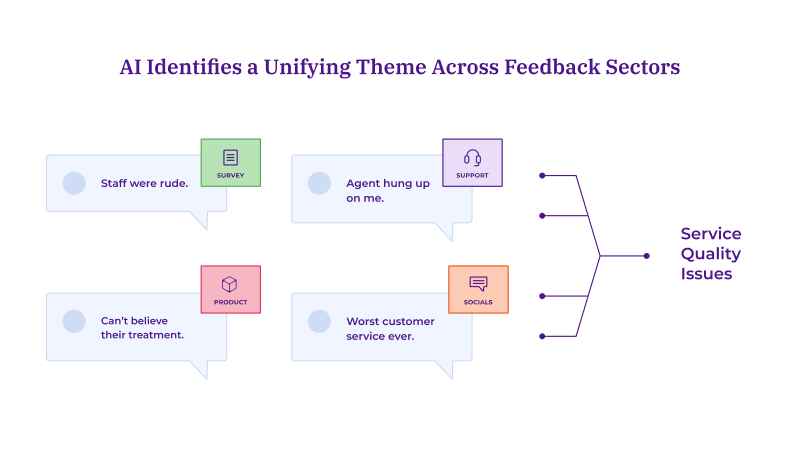
The same underlying issue might appear as "staff was rude" in surveys, "agent hung up on me" in support tickets, and "worst customer service ever" in reviews.
Taxonomy-based approaches require you to map all these variations to your pre-defined "service quality" category.
Thematic's AI-powered approach handles this complexity automatically, recognizing these as the same theme without manual mapping.
What value AI creates from unified feedback data
AI-powered analysis delivers three distinct advantages over traditional methods:
Impact quantification that separates volume from importance,
Cross-channel pattern recognition that reveals issues spanning touchpoints, and
Speed to insight that enables real-time response.
Thematic combines these capabilities into a transparent feedback intelligence layer that sits on top of existing platforms like Medallia and Qualtrics. It automatically discovers themes across all channels while giving Insights teams human-in-the-loop control to ensure research-grade accuracy.
Impact analysis quantifies which themes affect your metrics
Frequency doesn't equal importance. The most-mentioned issues aren't always the ones that matter most to your business.
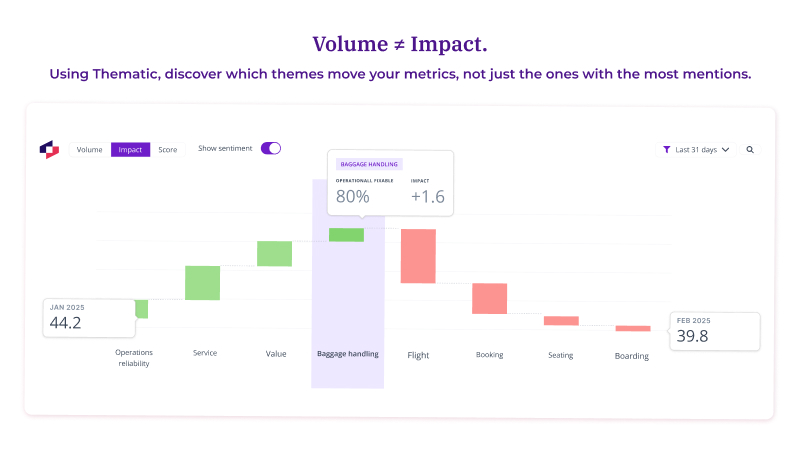
Orion Air discovered this when analyzing what drove their NPS changes. Baggage handling issues weren't the most frequently mentioned problem in customer feedback.
But when Thematic's AI quantified the impact, baggage issues showed a disproportionate effect on NPS and customer lifetime value. Even better, 80% of the baggage issues were operationally fixable with targeted improvements.
After making targeted improvements to baggage handling, Orion Air saw a 1.6-point NPS increase from that initiative alone, contributing to their overall 13% NPS improvement.
This gave Orion Air's team a clear priority: fix baggage handling first because it delivers the biggest NPS improvement for the effort invested. Counting mentions tells you what customers talk about. Impact analysis shows which themes actually move your metrics.
Volume ≠ Impact: Thematic quantifies which themes actually move your metrics, not just which get mentioned most.
DoorDash applies this principle when analyzing feedback from merchants, dashers, and consumers across multiple touchpoints.
By analyzing tens of thousands of NPS comments with Thematic, they identified "Merchant Frustration" as a theme driving their NPS decline, even though it wasn't the most frequently mentioned issue.
The culprit? Their Menu Manager interface. Merchants struggled with inefficiencies that made menu updates take 11 seconds per edit. DoorDash redesigned the tool, cutting load times to 3 seconds. Merchant NPS rebounded +8 points within two release cycles.
As Emma Glazer, Head of Dasher Marketing, explains: "It's about establishing priorities. You aren't thinking about the whole universe, you've got these three or four themes that might be disproportionately impacting our scores."
Speed to insight enables real-time response
Manual analysis can take weeks to reach stakeholders. By then, the opportunity to address emerging issues quickly has passed.
According to the Forrester Total Economic Impact study, leading AI-powered feedback analysis platforms can reduce analysis time by over 90%. Greyhound reduced their analytics time tenfold; what once took 3 hours to 3 days now happens in minutes.
This speed transformed how station managers operated.
Instead of waiting for monthly reports, they could spot location-specific issues the same day and respond immediately. The capacity this freed up was just as valuable as the speed improvement.
Cross-channel patterns reveal the complete picture
Some issues only become visible when you analyze all channels together. A problem might seem minor in surveys, negligible in support tickets, and barely mentioned in reviews. But when you see it across all three channels affecting the same customer segments, it reveals itself as significant.
AI-powered feedback analysis platforms connect feedback from the same customers across different touchpoints automatically. This creates a complete picture of individual customer journeys that single-channel analysis misses.
AI recognizes the same underlying issue across channels, regardless of how customers phrase it.
How to evaluate AI capabilities in customer feedback analytics platforms
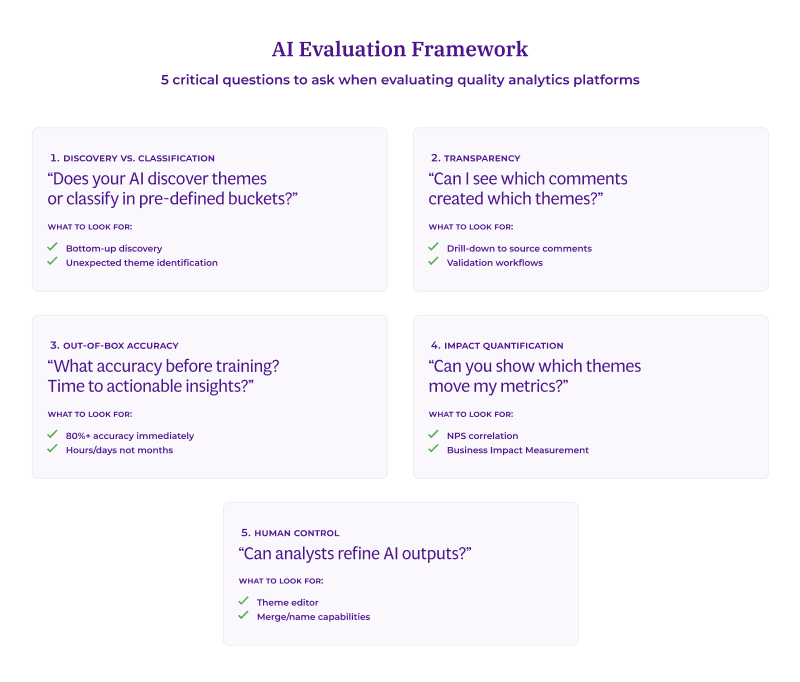
When evaluating AI-powered feedback analytics platforms, focus on five critical capabilities:
Discovery versus classification,
Transparency and defensibility,
Out-of-box accuracy,
Impact quantification, and
Human-in-the-loop control.
Remember that AI tools for feedback analysis are not all the same. Some platforms use AI to automate taxonomy-based classification. Others use AI for true bottom-up discovery.
Understanding this distinction helps you evaluate vendor claims accurately.
Five critical questions to ask when evaluating AI-powered customer feedback analytics platforms.Type image caption here (optional)
Discovery versus taxonomy: Does it find themes or categorize into buckets?
The most important question to ask vendors: "Does your AI discover themes from my data, or does it classify feedback into pre-defined categories?"
Taxonomy-based platforms augmented with AI still require you to define categories upfront. The AI automates classification into your buckets, which is faster than manual coding. But you're still limited to finding what you thought to look for.
Discovery-based platforms find themes directly from your feedback without pre-built categories. The AI identifies patterns, groups similar feedback, and surfaces themes you didn't know existed.
Some platforms combine both approaches. Thematic uses a hybrid model: combining traditional text analytics with large language models, selecting the best method for each task. This delivers the precision of proven techniques alongside the flexibility of modern AI.
When evaluating vendors, request to see both approaches with your actual data.
Does the platform surface unexpected themes? or
Does it only report on categories you configured?
Transparency: Can you see why themes were identified?
Black-box AI undermines stakeholder confidence. When executives question insights, you need to show exactly which customer comments support your conclusions.
Transparent AI feedback analysis platforms let you drill down from any theme to the specific comments that created it. This traceability is essential for defending insights to skeptical stakeholders and validating that the AI correctly identified patterns.
When evaluating platforms, ask:
Can I see the exact customer comments that created each theme?
Can I verify the AI's work?
Out-of-box accuracy: Does it work immediately or require months of training?
Some platforms require extensive training periods before they deliver accurate results. You provide thousands of manually coded examples, the system learns from your labels, and gradually improves over time.
The Forrester Total Economic Impact study reports that leading AI-powered feedback analysis platforms achieve 80%+ accuracy out-of-the-box without training periods. You connect your data and start getting insights within hours or days, not months.
The key question to ask vendors:
What accuracy can you achieve with my data before any training?
How long until I have actionable insights?
Impact quantification: Does it show what matters or just what's mentioned?
Counting mentions tells you what customers talk about. Quantifying impact tells you what actually affects your business metrics.
Platforms with true impact quantification capabilities can answer:
Which themes correlate with NPS changes?
Which issues affect high-value customers more than others?
What's the business cost of this problem?
This capability requires the platform to connect feedback themes to outcome metrics like NPS, CSAT, retention, or revenue.
Not all platforms offer this.
Many stop at frequency counting and sentiment scoring.
When evaluating vendors, ask them to demonstrate impact analysis with your metrics.
Can they show which themes move your NPS?
Can they quantify the business value of fixing specific issues?
Human-in-the-loop control: Can analysts refine AI outputs?
The best AI-powered feedback analysis platforms combine automatic discovery with human validation. The AI finds themes quickly at scale. Analysts verify, merge, rename, or split themes to match business terminology and ensure accuracy.
This human-in-the-loop approach delivers both speed and defensibility. You get AI efficiency without sacrificing the ability to validate and refine results.
You can merge similar themes, rename them to match your business language, and validate that the AI correctly grouped feedback. These changes apply immediately across all your analysis.
Some good questions to ask vendors:
Can my analysts modify AI-discovered themes?
Can we rename, merge, or split themes to match our business terminology?
Turning multi-channel feedback into actionable intelligence
The Integration-Analysis Gap separates organizations that collect feedback from those that act on it.
Thematic bridges this gap by combining automatic theme discovery with transparent, human-in-the-loop control. So it delivers research-grade analysis that's fast enough for agile decisions and defensible enough for executive reporting, all while sitting on top of your existing feedback platforms.
Unified data without AI-powered analysis creates a bigger collection of feedback, but finding actionable patterns still takes too long.
AI-powered discovery finds the needles automatically, quantifies their impact, and surfaces patterns you wouldn't think to look for.
Ready to see AI-powered analysis in action?
Thematic is a customer feedback analytics platform with native connectors for major survey, support, review, and CX platforms. You can also import data via API, SFTP, or file upload for maximum flexibility. Connect new data sources and start analyzing within hours, not months.
Request a demo to see how Thematic transforms your multi-channel feedback into actionable intelligence.
Frequently asked questions
Does AI replace human analysts?
No. AI augments analysts rather than replacing them.
AI excels at the time-consuming work of reading thousands of comments, identifying patterns, and grouping similar feedback at a speed and scale that humans can't match manually. Analysts bring irreplaceable value: validating AI findings, providing business context that AI lacks, and making strategic decisions about priorities.
Greyhound's experience illustrates this clearly: AI-powered analysis freed their team from manual coding work, giving them capacity to launch 4 backlogged research projects that required human strategic thinking. The result is better outcomes than either AI or humans could achieve independently.
How accurate is AI-powered customer feedback analysis?
Modern AI-powered feedback analysis platforms achieve 80%+ accuracy out-of-the-box when discovering themes. This accuracy improves over time as analysts refine themes through human-in-the-loop validation.
Thematic is an AI-powered feedback analytics platform that achieves 80%+ accuracy immediately by combining automated theme discovery with transparent human-in-the-loop validation, allowing researchers to verify and refine themes through an intuitive Theme Editor for research-grade results.
Transparent systems let you verify accuracy by reviewing the specific comments assigned to each theme, ensuring the AI correctly identified patterns. Accuracy also depends on data quality. Feedback with clear, specific descriptions generates more accurate themes than vague, single-word responses.
How does Thematic's AI work?
Thematic combines traditional text analytics with large language models, selecting the best approach for each task. The platform has been refined over years of real-world feedback analysis and continuously adopts the latest AI models. This hybrid approach delivers both the precision of proven methods and the flexibility of modern AI — with transparent results you can verify and refine.
What if our feedback is in multiple languages?
AI-powered feedback analysis platforms with multilingual capabilities can analyze text across languages and unify themes automatically. The AI identifies that "slow service," "servicio lento," and "service lent" express the same theme despite different languages.
This creates unified themes across your global feedback without requiring manual translation or separate analysis per language. When evaluating platforms, ask specifically about language support: "Does your AI handle multiple languages natively? Can it create unified themes across languages?"
How do I get started with AI-powered customer feedback analytics?
Getting started with AI-powered customer feedback analytics requires two things: unified feedback data and a platform that can analyze it. If you've already integrated your feedback sources, the next step is testing AI capabilities with your actual data.
Look for trials that connect to your real feedback sources rather than demos with vendor sample data.
Thematic is an AI-powered feedback analytics platform that works right away with your multi-channel data (no training period, no consultants, no months of setup) while giving Insights teams transparent control to ensure every theme is auditable and defensible for executive reporting.
This shows you exactly how the AI performs with your specific feedback patterns, volume, and business context.
Share
Link Copied!
Request a demo of Thematic's Customer Intelligence Platform
Thematic turns fragmented feedback into one consistent source of customer truth — so every team acts on the same customer story. Up and running in days, not quarters.
Thank you! Your submission has been received!
Oops! Something went wrong while submitting the form.