Customer feedback predicted Spirit Airlines' collapse a year before it happened
Spirit Airlines collapsed in May 2026; but the warning sat in customer reviews for more than a year. Here's what the signal looked like, why average scores hid it, and how to read your own leading indicators before they reach the headlines.
Experience Is the Promise: What Airline Reviews Reveal About the Gap Between Brand and Reality
A research collaboration with Experience Investigators analyzing thousands of airline reviews to reveal where brand promises break down, and what CX leaders can do to close the gap.
Spirit Airlines collapsed in May 2026, but the warning was visible in customer reviews more than a year earlier, with bottom-score Value reviews climbing from roughly 15% in 2024 to over 40% by early 2026.
Thematic analyzed around 2,000 airline app reviews, scoring each against the airline's brand promise and surfacing the themes behind each score (for Spirit, baggage fees and surprise charges).
Spirit's average score looked fine the whole time because averages flatten polarization, blending die-hard fans and furious customers into a number that says nothing is wrong.
Delta, by contrast, held customer trust through the same fuel shock thanks to strong Empathy scores from recovering well when flights went wrong.
The lesson: stop reporting only the average, watch the distribution and trend, tie every score to its theme, and track it over time so feedback becomes an early-warning system.
On May 2, 2026, Spirit Airlines ceased all operations. It was the carrier's second bankruptcy in under a year, and from the outside the end looked sudden. It was not. The warning had been sitting in customer reviews for more than a year.
Months before the headlines, Thematic's analysis of airline app reviews showed Spirit's core promise breaking in the data. The share of reviews that scored Spirit's value at the very bottom of the scale kept climbing: roughly 15% in 2024, 37% in 2025, and over 40% by early 2026. Read that way, customer feedback was a leading indicator of business failure. The signal was readable. Someone had to be reading it.
This piece walks through what the Spirit signal looked like, why average scores hid it, and what separated the airline that read its feedback from the one that did not. It draws on research Thematic ran with Experience Investigators across roughly 2,000 airline app reviews.
The signal was in the data for more than a year
The study analyzed about 2,000 App Store reviews across six US airlines over the full year of 2025. Three sat in the top tier of AirHelp's 2025 rankings (American, United, Delta) and three in the lower tier (JetBlue, Breeze, Spirit). Each airline makes an explicit brand promise, so the question was simple: do the airlines that rank best actually deliver on what they promise?
To answer it, Thematic used two AI agents. A scoring agent predicts how each reviewer would have rated the airline from 1 to 5 on five customer experience attributes, as if they had filled out a survey: Ease, Reliability, Value, Fairness, and Empathy. So a review that says "love the airline but the app has been a problem" might land at 2 out of 5 on Ease and 4 out of 5 on Value, pulled from the same few sentences. A theming agent then surfaces the specific themes driving those scores up or down. Score plus theme tells you not only whether the promise held, but which operational moments made or broke it.
Spirit's promise was Value: "Less Money. More Go." At a glance, Spirit's average Value score looked like everyone else's. The distribution did not. 37% of Spirit reviews scored Value at 1 out of 5, against a 31% group average. The average was hiding a brand in free fall.
The trend was the real tell. The proportion of bottom-score Value reviews ran near the group at about 15% in 2024, jumped to 37% in 2025, and pushed past 40% by early 2026. The driver was consistent: baggage fees and surprise charges. After its first bankruptcy, Spirit changed how it bundled fares and made some fees dynamic. When fuel prices spiked, that was the last straw. The cost model and the fuel shock finished the airline, but the erosion of customer trust was visible in the reviews long before either made the news.
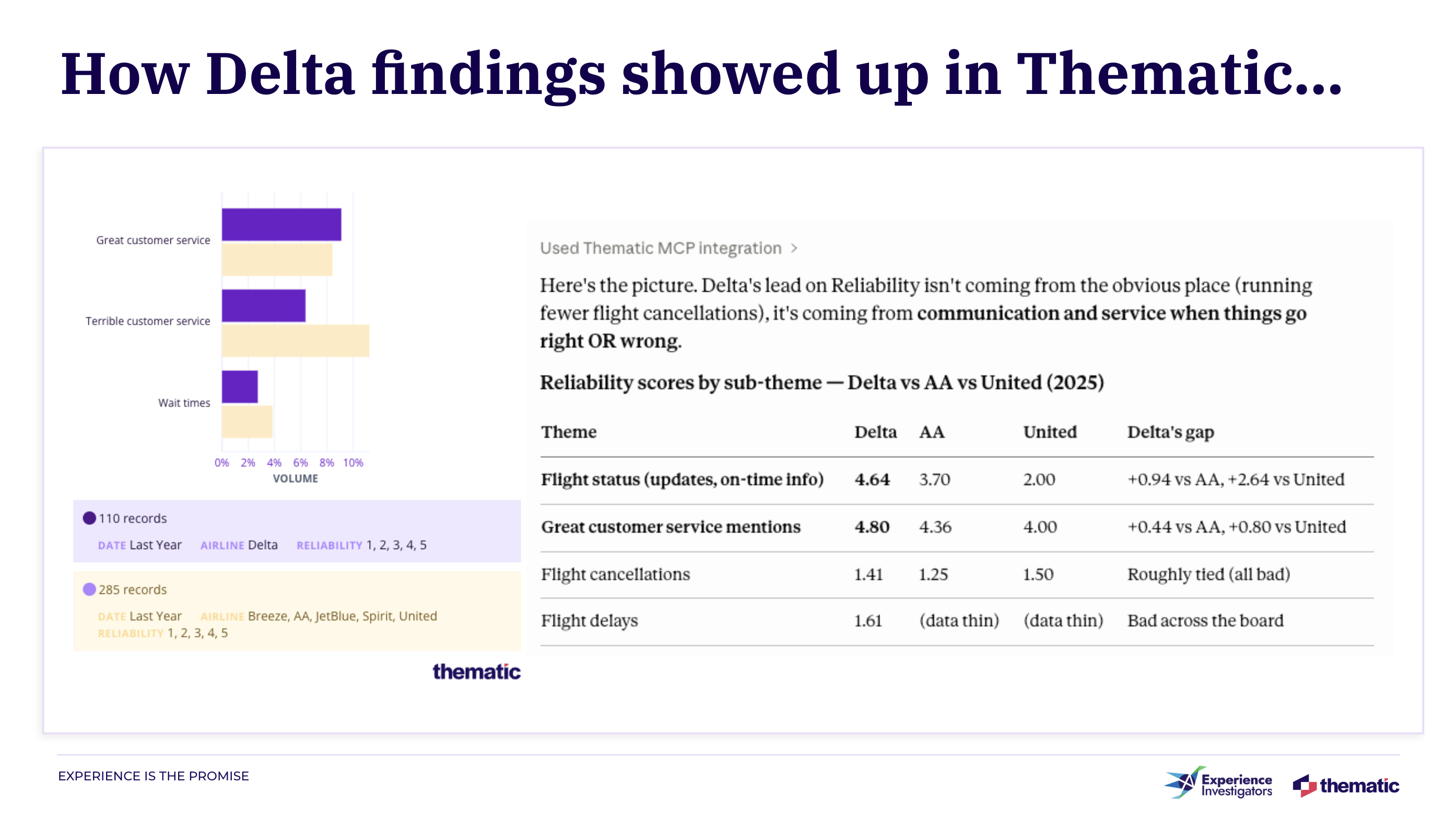
Delta's reliability lead over AA and United comes from communication and service quality, not fewer cancellations -- scoring 4.64 on flight status updates versus United's 2.00, as surfaced via Thematic's MCP integration.
Why the average hid the warning
Spirit's average Value score looked fine because averages flatten polarization. Spirit had die-hard fans who loved the low base fares and a growing crowd of furious customers who felt nickel-and-dimed. Blend the two and you get a number that says nothing is wrong. Jeannie Walters, founder of Experience Investigators and author of "Experience Is Everything," calls the habit of reporting that number and moving on being a "number narrator." The average gets reported, the report says the average is fine, and the signal underneath never surfaces.
Two moves break the average open. The first is predicting a score from each individual review, so you see the full distribution instead of one blended figure. The second is attaching the theme behind each score, so you see the reason. A score tells you something changed. A theme tells you what to fix.
This is also how you catch signals no survey question would ask for. Take a supermarket that wanted to be the most trusted grocery brand in its market. No customer writes "I trust you" in a review. They write that the tomatoes advertised as cheap rang up at eight dollars a kilo. The trust signal lives in the theme, not in any scaled question. A single number is a lagging snapshot. The distribution and the themes are the leading indicator.
What reading the signal looks like
Set Spirit next to Delta and the difference is stark. Delta promised Reliability with "Keep Climbing," and on Reliability it scored about the group average. Its real edge showed up in Empathy, where it scored 2.8 against a 2.5 group average. The reason was recovery. When flights went wrong, Delta drew roughly half as many reviews calling customer service terrible as its peers did. Delta's advantage was not that it never failed. It was that it failed better, in ways that preserved trust.
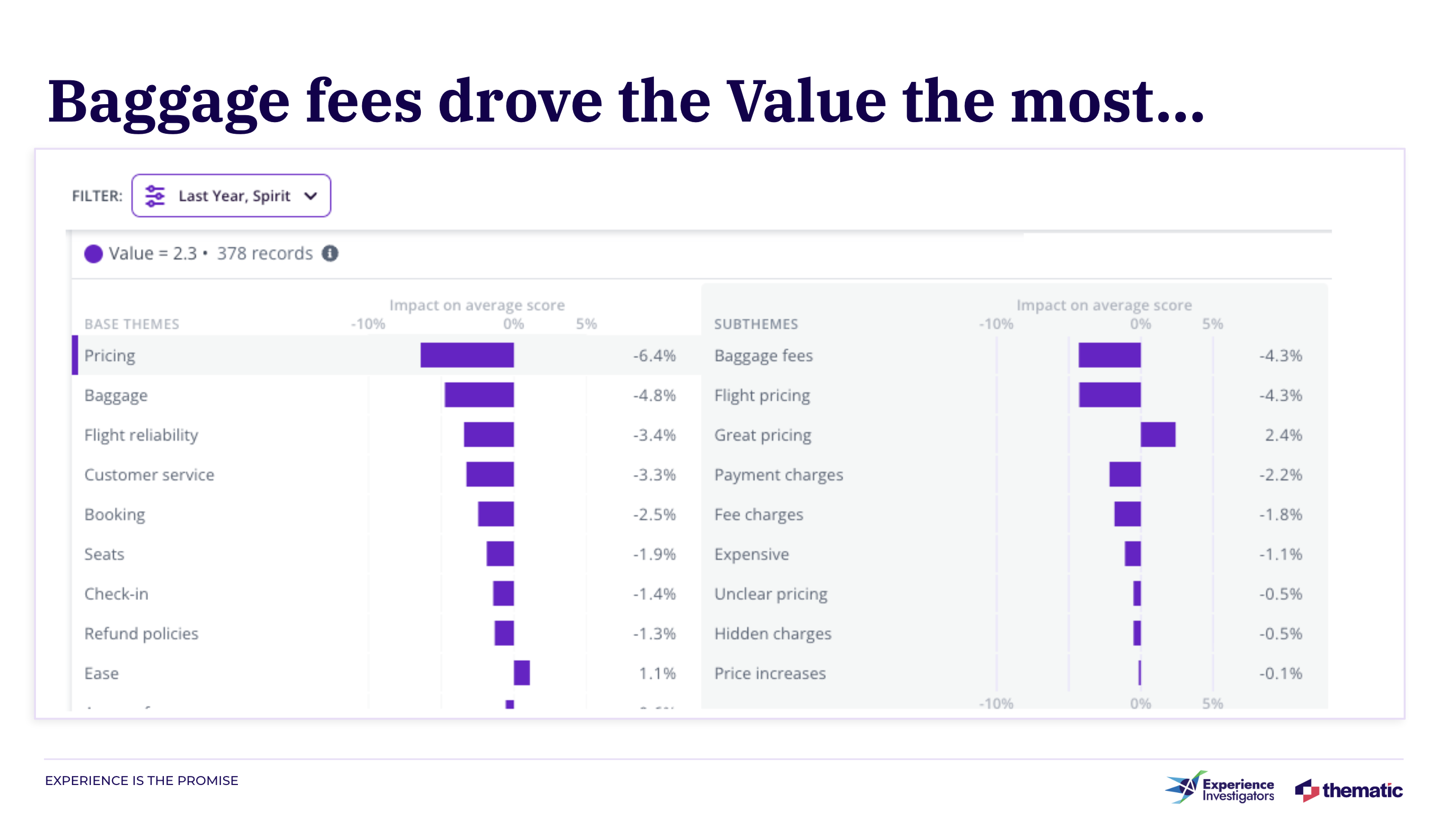
Baggage fees were the single biggest drag on Spirit's Value score, contributing a 4.3% negative impact alongside flight pricing, with pricing-related themes collectively accounting for the largest share of dissatisfaction.
Same industry, same turbulence, opposite outcomes. The fuel-price shock that finished Spirit hit every carrier. Delta had built its operations to deliver the promise under pressure: recovery investments, staffing, training. Spirit's operational choices, including unbundled fees, opaque charges, and slow refund flows, widened the gap with customers every time something went wrong.
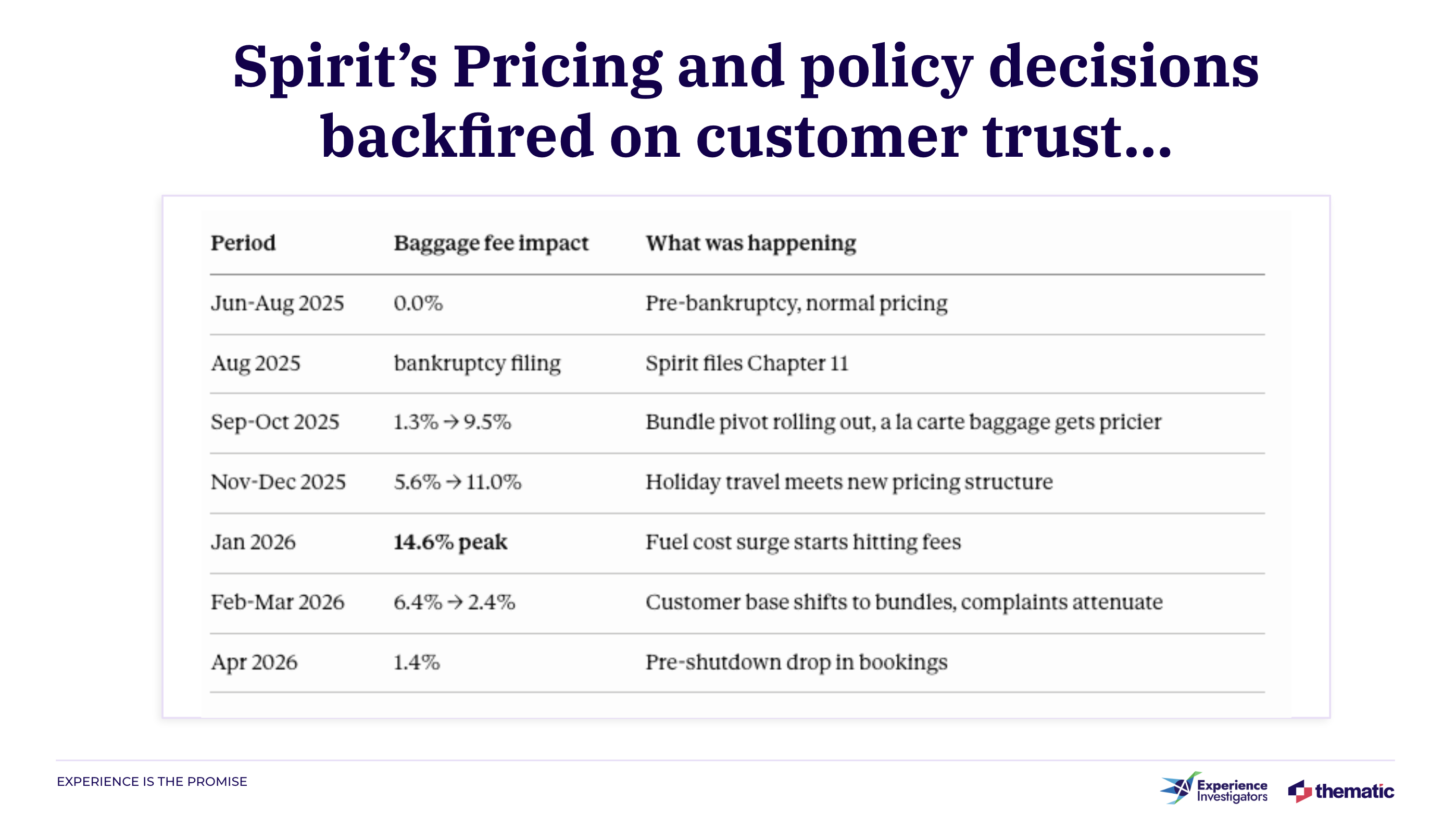
Spirit's pricing and policy decisions eroded customer trust from bankruptcy filing through shutdown, with baggage fee impact peaking at 14.6% in January 2026 before declining as customers shifted to bundles.
The most surprising finding was that Breeze, not Spirit, won on Value, scoring 2.6 against Spirit's 2.3, even though both compete on price. The theme most closely linked to high Value at Breeze was great staff. Customers tied service quality directly to whether they felt they got their money's worth. Value is not price. It is perceived honesty.
Two airlines, two outcomes, one lesson:
Delta
Spirit
Brand promise
Reliability ("Keep Climbing")
Value ("Less Money. More Go.")
What the reviews showed
Empathy above the group (2.8 vs 2.5), strong recovery when flights went wrong
Bottom-score Value reviews climbing from 15% to over 40% in two years
Operational choices
Recovery investment, staffing, training
Unbundled fees, opaque charges, slow refund flows
Outcome
Trust held through disruption
Trust broke, then the airline did
Both signals were in the customer feedback. Both were readable in real time.
How to read your own leading indicators
The airline data is really a lesson about alignment. It maps to three commitments from "Experience Is Everything":
Mindset. Can every team describe the experience you have promised, in roughly the same words?
Strategy. Are your operational decisions, your policies and trade-offs, designed to deliver that promise when things go wrong?
Discipline. Would you know, today, if customers' experience of the promise was already breaking?
Discipline is where most teams have the gap, and it is the most fixable. Four habits close it:
Stop reporting only the average. Watch the distribution and the trend, because that is where polarization and decline show up first.
Read across all your feedback, not just the survey score. That means reviews, support tickets, social posts, and the open-ended text inside the surveys you already run.
Tie every score to the theme driving it, so you see the why while you can still act on it.
Track it over time, so a slow erosion registers as a trend instead of getting lost as noise.
This is the work Thematic is built for. Its scoring agents put a number on unstructured feedback so you can track it like a metric. Its theming agents surface the drivers so you know what is moving it. Run that against your own brand promise and a pile of reviews becomes an early-warning system.
The signal was readable. The question is whether anyone is reading.
Spirit's collapse had many causes: a thin-margin model, a fuel shock, a failed bailout. But the loss of customer trust that sat underneath all of it showed up in feedback long before the wind-down notice. The data was readable in real time. The only open question was whether anyone was paying attention.
The same is true in your business. Customers are telling you where the promise is breaking before it reaches the numbers that make headlines. The advantage goes to the teams that read the signal early enough to do something about it.
Want to see what your customer feedback is already telling you about your brand promise? Talk to one of our experts at getthematic.com.
Share
Link Copied!
Request a demo of Thematic's Customer Intelligence Platform
Thematic turns fragmented feedback into one consistent source of customer truth — so every team acts on the same customer story. Up and running in days, not quarters.
Thank you! Your submission has been received!
Oops! Something went wrong while submitting the form.