Abstract illustration of layered geometric shapes in purple and pink gradients, representing stacked data layers in a feedback analytics system.

Custom Scores: The missing metrics layer for modern VoC

VoC leaders need decision-grade metrics, but the richest customer signals live in unstructured text where "the number" is missing. Thematic's Custom Scores close that gap, turning feedback you already have into measurable outcomes you can trend, segment, and act on.

Insights
>
>
Custom Scores: The missing metrics layer for modern VoC
While you're here
The Professionals’ VoC Handbook
The only handbook you will ever need to level up your Voice of Customer game!

TLDR

  • The richest customer feedback lives in unstructured text (chats, reviews, tickets, calls), but without a linked rating, it's hard to trend or compare.
  • Thematic's Custom Scores are AI-generated metrics that turn that text into trackable outcome scores, without adding survey questions.
  • You define what to measure in plain language, validate against real examples with human-in-the-loop review, then trend and segment like any traditional metric.
  • Go beyond generic CX: measure trust, churn propensity, release quality, customer effort, and more across channels and teams. It's how VoC moves from insights reporting to cross-functional decisioning.

VoC leaders are being asked to do something impossible: turn messy, multi-channel feedback into decision-grade numbers that executives can trust and act on, without drowning customers in surveys.

Here’s the core challenge: the richest signals don’t live in rating scales. They live in chats, reviews, calls, tickets, and complaints—where “the number” is missing. You can report themes, but you can’t trend outcomes with confidence across channels, product lines, or time.

Take a simple example. You know customers are frustrated with packaging.

But which aspect is driving it? Is it damage, sustainability, unboxing, labeling, or delivery handling? And how is it changing by product line?

The evidence is in the text, but without a consistent metric, it’s hard to prioritize investment or prove impact.

That’s why traditional approaches force an ugly tradeoff. NPS and CSAT are too blunt to steer action. Surveys can be slow and rigid (and add fatigue). Meanwhile, unstructured analysis can be insightful, but hard to standardize into a metric leaders will run on.

At Thematic, we built Custom Scores to close that gap: business-specific outcome metrics derived from the feedback you already have. Now you can measure what matters without adding another scale question!

What are Custom Scores?

Custom Scores are synthetic, AI-generated metrics that quantify outcomes from unstructured text. You define in plain language what you want to measure and Thematic produces consistent, metric-like scores across datasets, even when there’s no linked rating. 

Instead of forcing every question into “satisfied/not satisfied,” you choose the outcome construct that matters to you. That might be a familiar metric you want to scale across channels (synthetic NPS, CSAT, Customer Effort), a harder-to-measure objective (trust, release quality, engagement), or something closer to financial impact (propensity to churn, likelihood to expand an account).

At Thematic, we deliver this as a framework that makes Custom Scores easy to set up and operationalize. Once created, Thematic derives the score from raw text, then shows what’s driving movement, how it’s trending over time, and where it’s strongest or weakest by segment.

Think of it as adding a new layer to your VoC system:
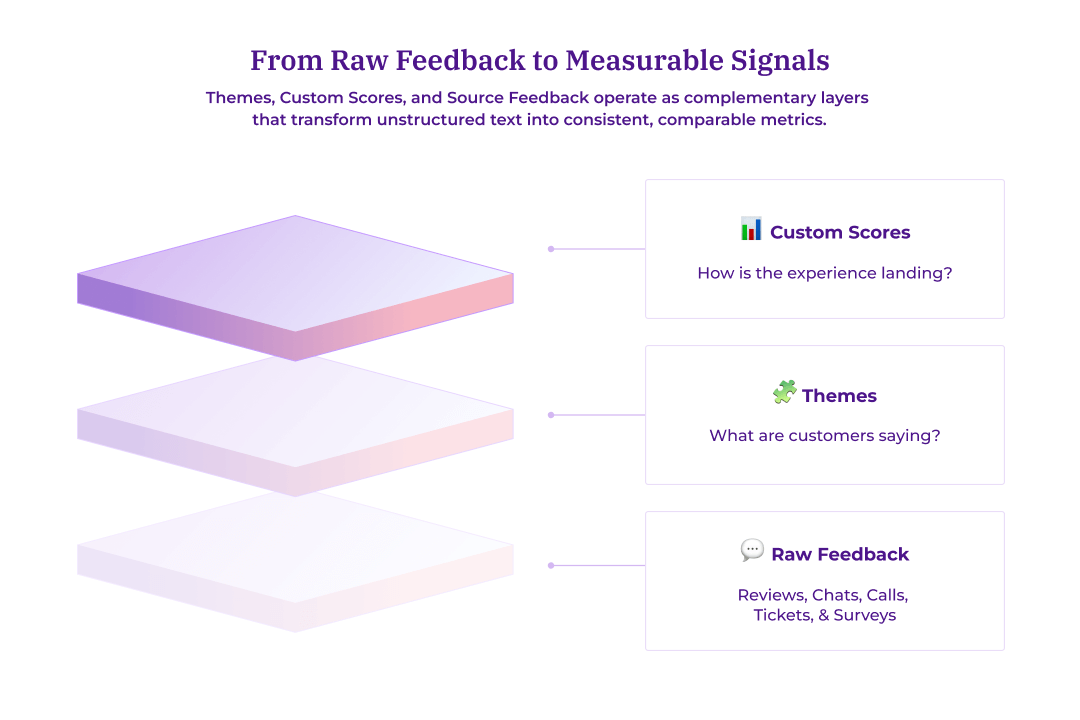
  • Themes tell you what customers are talking about.
  • Custom Scores tell you how that experience is landing against your chosen outcome.
  • Together, you can measure what you can influence, and prioritize actions that will move the outcome.
Diagram showing three stacked layers: Raw Feedback at the bottom (reviews, chats, calls, tickets, and surveys), Themes in the middle (what are customers saying), and Custom Scores on top (how is the experience landing).
From raw feedback to measurable signals: Themes, Custom Scores, and source feedback operate as complementary layers that transform unstructured text into consistent, comparable metrics.

This approach is already in use with our customers in retail, financial services, and high-tech to standardize outcomes across channels without oversurveying.

Here’s how they see the key benefits of this approach:

  • Custom Scores let you measure what can be managed, across teams and channels.
  • Because you can now make surveys shorter, this approach improves response rates and reduces survey fatigue.
  • They increase the value of existing unstructured feedback, making feedback comparable and trendable, even without linked ratings.
  • They reduce reliance on scale questions and post-interaction surveys (e.g., touchpoint sNPS without post-call surveys).
  • Surface drivers and segments automatically, so teams know what to fix first. Extend VoC beyond CX into cross-functional decisioning (Product, Ops, Support, Revenue).

Why this matters now

The organizations winning with VoC are moving from “insights reporting” to continuous decisioning. Not because insights are less important—but because decisions need measurable outcomes.

  • Operations: Where are the bottlenecks, and what’s driving reliability?
  • Marketing: Are we delivering on the promises we make?
  • Product: Did this release make the experience better in the ways that matter?
  • Revenue: Where are the early signals of churn or expansion?
  • Support: What’s driving effort and friction?

Custom Scores make those outcomes measurable, even when customers don’t provide a score.

Diagram showing five teams (Operations, Marketing, Product, Revenue, and Support) each with a distinct focus area, all connecting into one unified view of customer feedback.
A single source of feedback can generate insights that support decision-making across multiple teams.

How it works in Thematic: Define → Validate → Track

Custom Scores are designed to be practical, not theoretical. The flow is straightforward:
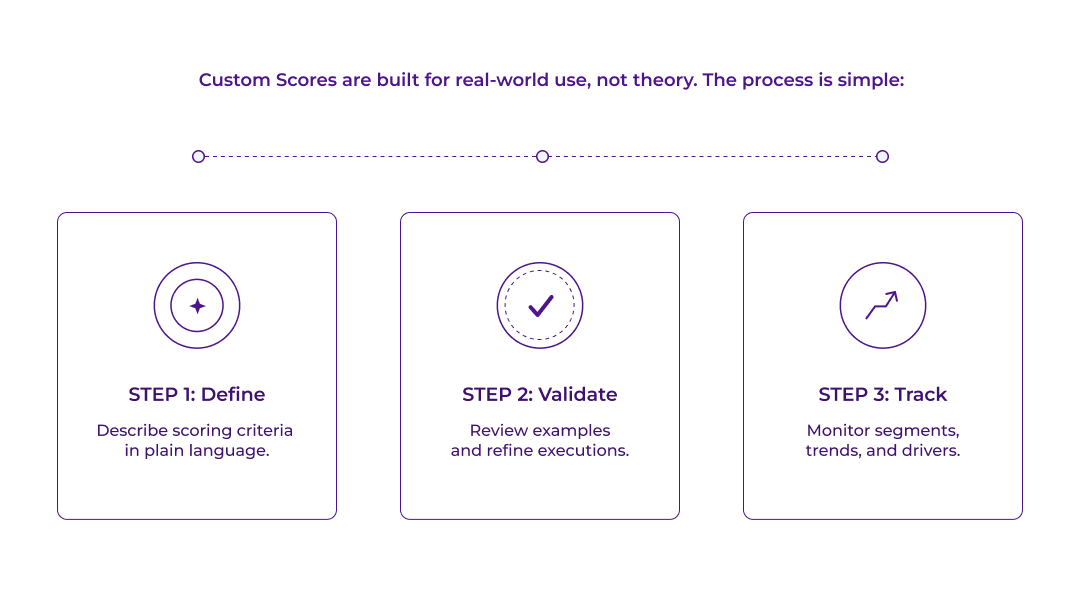
  1. Define the score: Choose what you want to measure and describe the scoring criteria. 
  2. Validate and refine: Thematic generates score categories/classes from your description, and shows you examples. You can spot-check real examples. Thematic uses any corrections to refine the score’s classification.
  3. Track and act: Once you “turn on” a score, you can monitor trends, compare segments, see what’s driving movement via thematic analysis tools and dashboards, and export scores for external reporting.
Three-step process for Custom Scores: Step 1 Define (describe scoring criteria in plain language), Step 2 Validate (review examples and refine executions), Step 3 Track (monitor segments, trends, and drivers).
Custom Scores are built for real-world use, not theory. The process is simple: define, validate, and track.

Under the hood, scores can be classified into buckets (e.g. high, low, irrelevant, unknown) or a numeric scale.
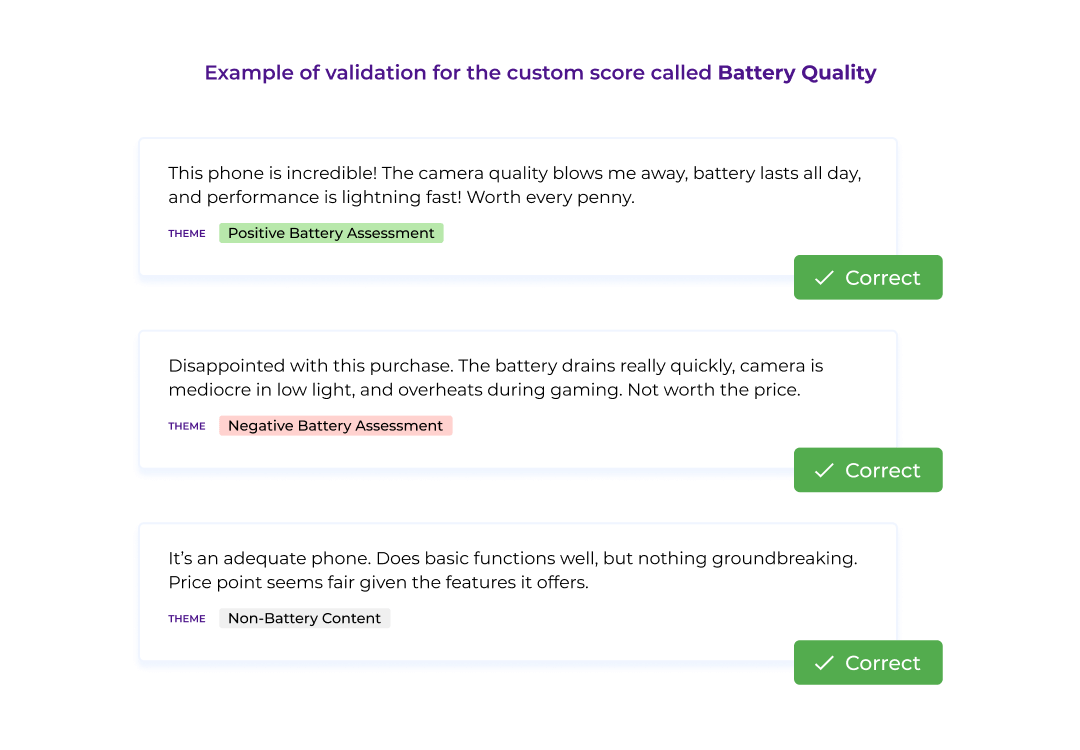
Three customer feedback examples being validated for a Custom Score called Battery Quality. Each is classified as Positive Battery Assessment, Negative Battery Assessment, or Non-Battery Content, all marked as correct.
Example of validation for the Custom Score called Battery Quality, showing how Thematic classifies feedback into score categories for human review.

What you can measure (Beyond generic CX)

Customer feedback already flows through reviews, chats, tickets, calls, and surveys. Custom Scores make those signals comparable across channels, and actionable across the business.

Now one source of truth can answer different questions for different teams, without squeezing everything into one-size-fits-all score.

This is how VoC becomes cross-functional infrastructure: the same feedback stream can power different teams’ decisions, because you’re measuring outcomes they recognize.
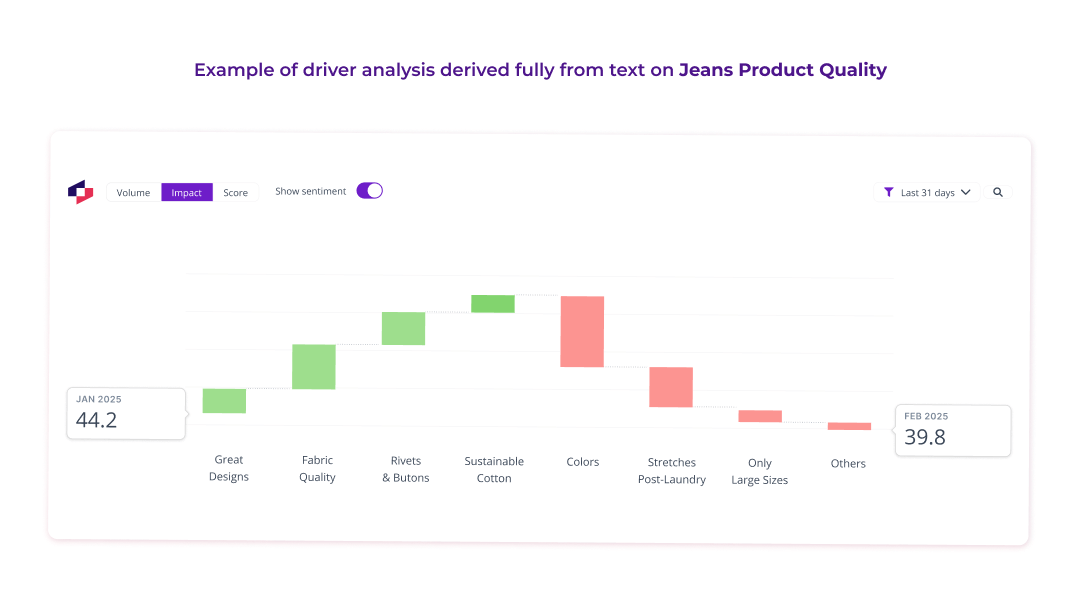
Waterfall chart showing driver analysis for Jeans Product Quality, with positive drivers like Great Designs, Fabric Quality, and Sustainable Cotton, and negative drivers like Colors, Stretches Post-Laundry, and Only Large Sizes, trending from a score of 44.2 in January 2025 to 39.8 in February 2025.
Example of driver analysis derived fully from text on Jeans Product Quality, showing what's pushing the score up or down over time.


Trust and governance: The score is not a black box

Custom Scores are meant to be directional and actionable, not magical.

The accuracy depends on the depth and clarity of the customer’s text (short responses may yield more “Unknown/Irrelevant” classifications) and how closely it matches the score definition.

The workflow itself is built around:
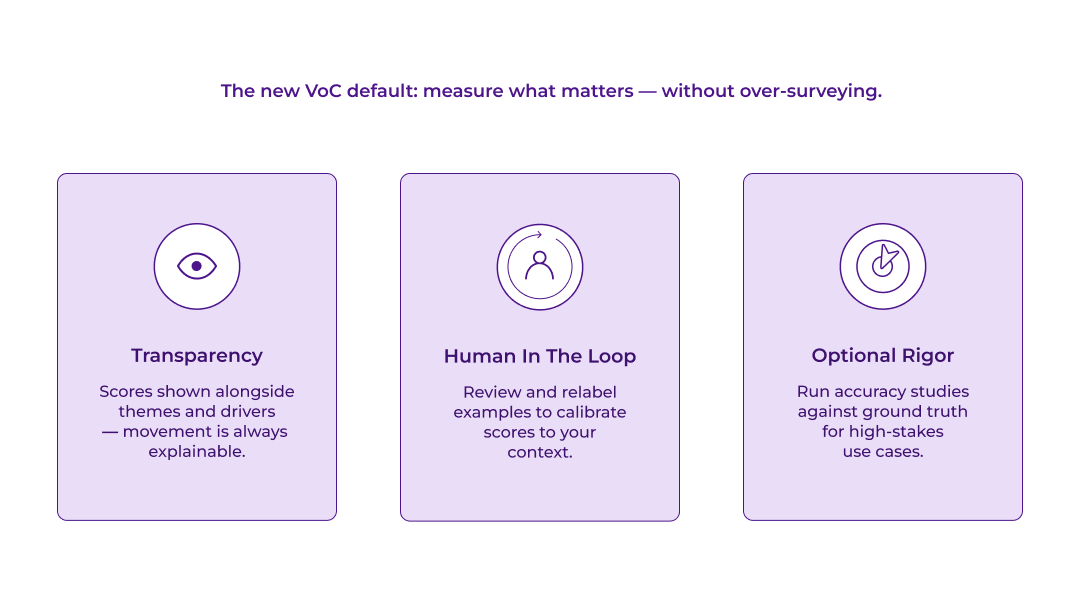
  • Transparency: Scores can be explored alongside themes and drivers, so movement is explainable.
  • Human-in-the-loop validation: Review and relabel examples to calibrate the score to your context.
  • Optional rigor when needed: For high-stakes use cases (like predictive churn), an accuracy study can be run if you have ground truth data.

The new VoC default: measure what matters—without oversurveying

Custom Scores are a bet on where VoC is going: away from “collect more ratings” and toward turning natural language into measurable outcomes that the business can run on.

If you’re already sitting on a mountain of feedback, you don’t need another dashboard. You need a way to standardize outcomes, trend them reliably, and connect them to drivers—so your stakeholders can make decisions with confidence.

Want to see Custom Scores on your own data? Book a demo.

1. Guide Analysis
Guides

Build, Buy or Partner? A Layered Guide to AI Feedback Analytics

Transforming customer feedback with AI holds immense potential, but many organizations stumble into unexpected challenges.