Deductive thematic analysis uses pre-defined themes to test hypotheses, making it faster than exploratory coding when you know what to look for.
Success requires three elements: an a-priori codebook, theoretical grounding, and reliability checks between coders.
Thematic supports deductive analysis with transparent codebook management, automated tagging at scale, and human-in-the-loop control.
Best for validating known theories or compliance checks; switch to inductive approaches for open-ended discovery.
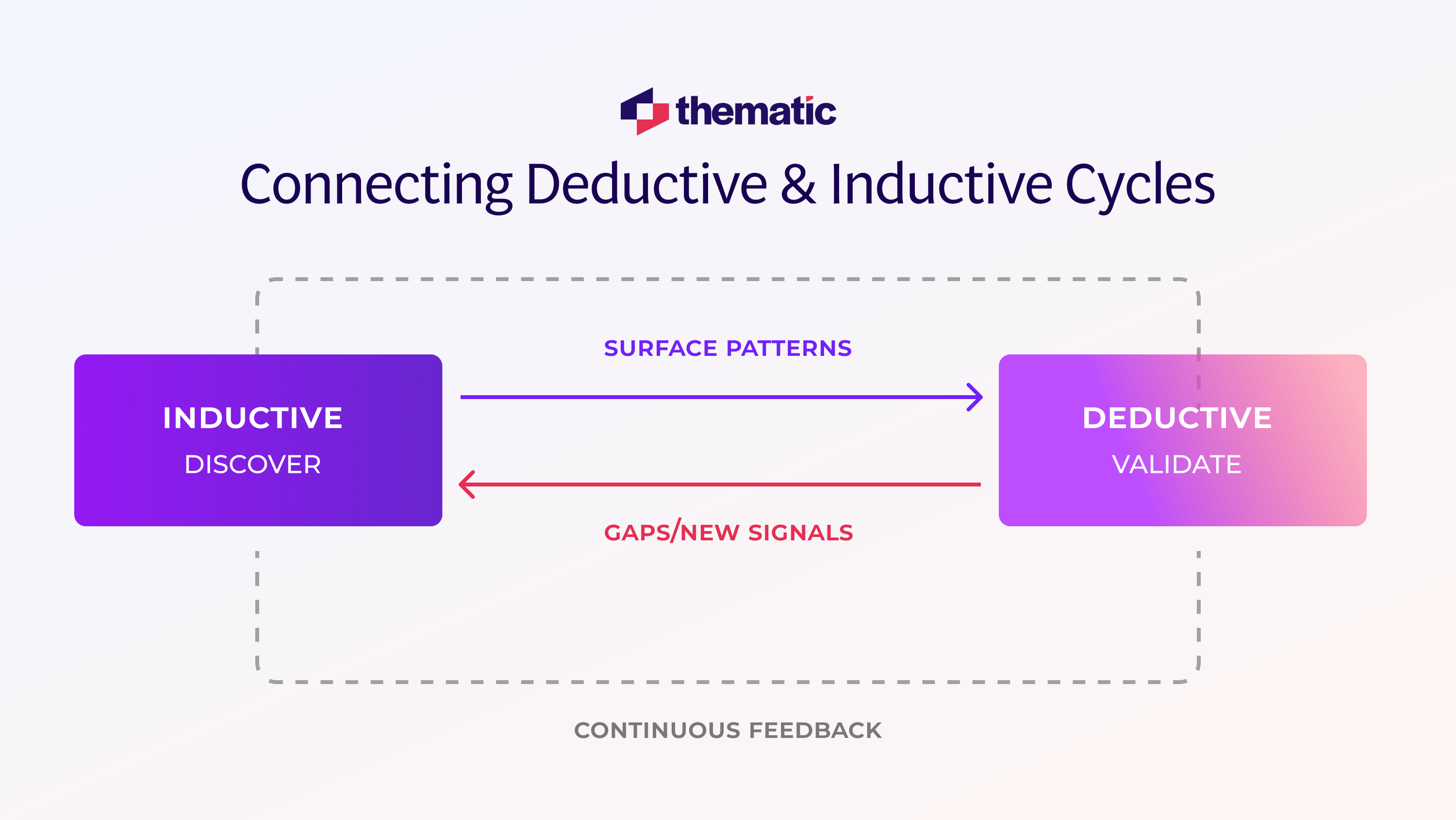
Smart teams cycle between deductive (theory-testing) and inductive (exploration) as their data evolves.
When you're sifting through customer feedback with a strong hunch about what's driving dissatisfaction, deductive thematic analysis is your go-to approach.
It's a theory-first method of qualitative data analysis. You start with predetermined themes or a hypothesis, then look for patterns in the data.
Say a product team suspects "response time" issues are hurting their support ratings. Using a deductive approach, they start with "response time" as a theme and tag all related comments.
Having a hypothesis saves hours. You're zeroing in on known problem areas instead of wading aimlessly.
In thematic analysis, neither approach is "better" universally. A deductive framework excels when you have specific questions to answer or existing theories to validate.
The deductive approach focuses your theory from the start, making it faster and more directed than purely exploratory methods. That's what we'll dive into today.
What makes deductive thematic analysis work?
Three core ingredients make this theory-first method of qualitative data analysis successful: codebooks, theoretical framing, and reliability checks.
A-priori codebooks set the roadmap
Deductive thematic analysis relies on an a-priori codebook, a list of themes or codes you decide on before analyzing the data.
It acts as your roadmap.
For example, if you're analyzing support tickets, you might start with categories like "Pricing," "Login Issues," and "Response Time" based on prior research or experience. Each theme in the codebook has a clear definition so everyone on the team understands what to tag.
In practice, you might document these definitions in a shared sheet or whiteboard to keep all analysts aligned.
It's like agreeing on the rules of a game before you start.
Theoretical framing anchors every theme
Your themes aren't random buckets. They're grounded in an existing theory or framework.
Imagine you're examining customer loyalty feedback using a well-known model like NPS drivers. Your codebook might align with those drivers (product quality, price fairness, service efficiency) to test if the theory holds true in your dataset.
Theory gives your analysis context and purpose from the start.
Reliability checks keep coders in sync
Deductive thematic analysis emphasizes reliability and consistency.
If multiple people are coding the data, you need to measure how much they agree on applying the codebook. This is where reliability metrics like Cohen's κ (kappa) and Krippendorff's α (alpha) come in.
These are simple statistical measures that show agreement between coders. Like checking if two people would score the same movie the same way, the closer these values are to 1, the more you can trust that your analysis is solid and not just one person's interpretation.
Why bother with these metrics? Because a theory-first approach strives for objectivity (you're testing a hypothesis), the evidence must be dependable.
The bottom line: come prepared with a codebook, ground it in theory, and verify that everyone's coding is in sync.
💡
Need a hand? Thematic's drag-and-drop Themes Editor lets you import ready-made codebooks or build new ones in minutes. Unlike black-box AI tools, you get transparent control to edit, refine, and validate every theme, making your analysis auditable and defensible for executive reporting.
Flexible Qualitative Analysis Software
See How Thematic Supports Both Deductive and Inductive Analysis Approaches
Busy insights teams can move from data to executive presentation in a single workday.
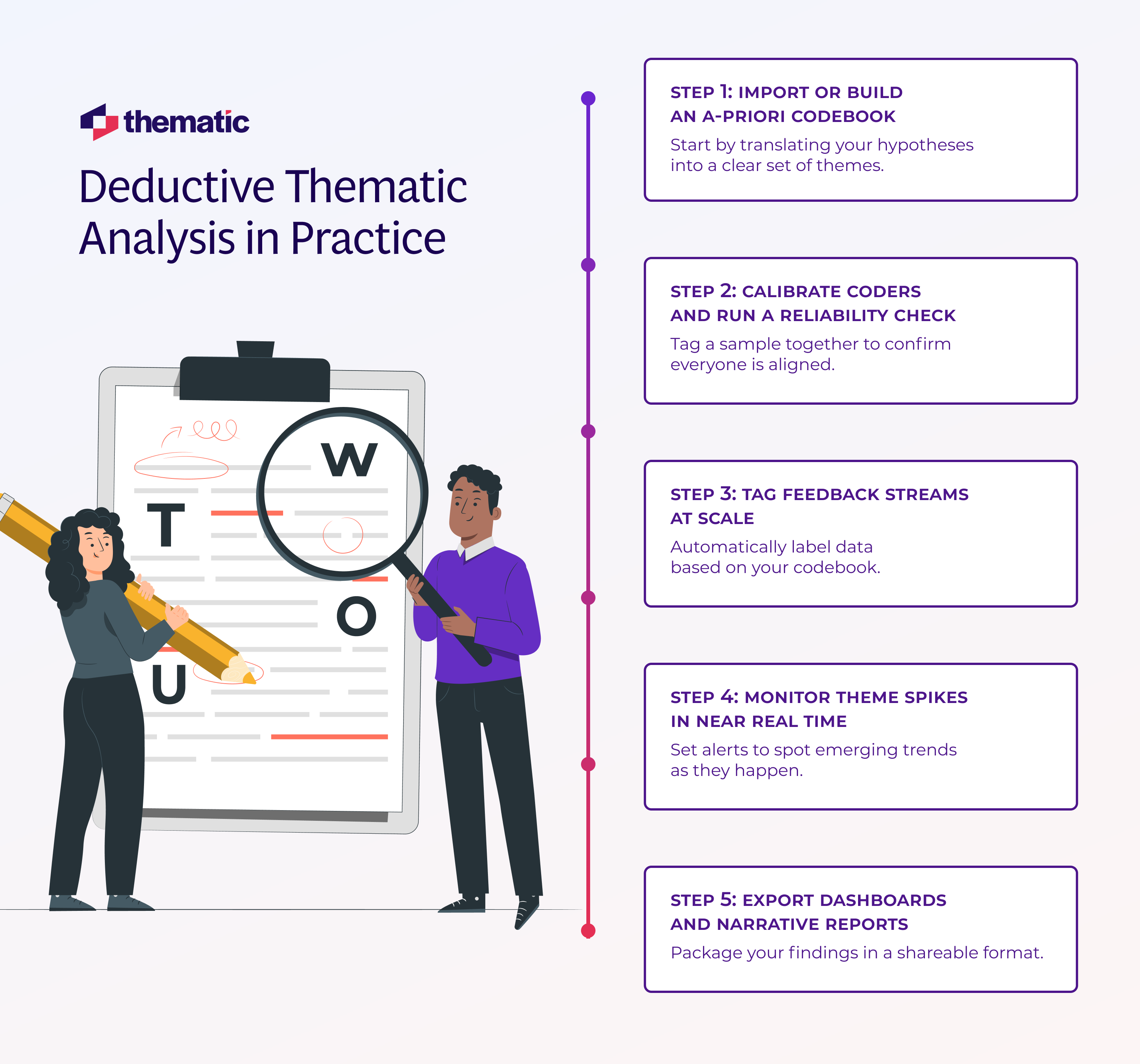
Here's a practical workflow you can adapt whether you use spreadsheets, statistical packages, or a purpose-built platform. Each step keeps your theory-first lens front and center while leaving room for quick course corrections.
Step 1: Import or build an a-priori codebook
Start by translating your hypotheses into a clear set of themes.
Many teams draft the codebook in a shared sheet, then upload it to their analysis software. Give every theme a snappy name, a one-sentence definition, and a few real examples (here's how coding qualitative data works best).
That detail prevents "theme creep" later on.
A retail team, for instance, might load themes like Delivery Time, Product Quality, and Price Fairness. With these themes, every data point has an obvious home. Your analysts aren't guessing where comments belong.
Step 2: Calibrate coders and run a reliability check
Before you analyze the full dataset, run a small pilot (say, 100 comments) to verify everyone tags consistently.
Anything below 0.75 often signals vagueness in your definitions.
A 10-minute sync call can clear up why Delivery Time looked fuzzy and nail down wording. By midday, you'll have tweaked or merged unclear themes and locked a solid codebook.
Step 3: Tag feedback streams at scale
With the codebook finalized, push it across your entire corpus: support tickets, survey verbatims, app-store reviews.
Modern text-analysis tools can batch-process thousands of lines in minutes. Even a manual pass works if the volume is small.
The key is automation rules: map synonyms (slow shipping, late package) to the same theme so every variation rolls up correctly.
The payoff? Your dashboard now shows how often each theory-driven theme surfaces, without weeks of hand coding.
Thematic automates this step by letting you import codebooks and auto-tag feedback at scale, while maintaining research-grade accuracy through human-in-the-loop validation.
Step 4: Monitor theme spikes in near real time
Set thresholds or simple scripts that flag unusual jumps in theme volume or sentiment.
Did Login Issues double overnight, or did sentiment analysis reveal a sharp dip in Onboarding Experience positivity?
A quick alert, whether via email, Slack, or a BI tool, lets you spot anomalies when they're small.
Ask yourself: "Is this a true trend or just noise?"
A 5-minute peek at the raw comments usually reveals the cause.
Step 5: Export dashboards and narrative reports
Finally, package your findings for stakeholders.
Most teams combine a theme-frequency chart, a sentiment trend, and a handful of verbatim quotes for color. Keep visuals simple: bar graphs for volume, line charts for change over time.
By end of day, you'll have a concise deck or live link to share in tomorrow's leadership meeting.
💡
Sounds complex? Run your data through Thematic's integrations, and let the platform auto-tag, surface spikes, and share insights via its lightweight Workflows. The system maintains transparent, auditable records of every coding decision. No extra scripting required.
When deductive thematic analysis delivers ROI
Deductive thematic analysis pays off when you already have a clear hypothesis or regulatory checklist to test.
It falls short when you need open-ended discovery or you're working with tiny, highly nuanced datasets.
The tables below spell out the ideal situations and red-flag scenarios, backed by recent industry and research sources.
Where deductive analysis excels
voice of customer programs, where feedback themes align with known business drivers.
When to choose another approach
Even champions of deductive thematic analysis warn that a theory-first lens has limits. If your codebook is too rigid, you may overlook fresh patterns, inject bias, or struggle with reliability when cases are few or contexts shift quickly.
Caution flag
Why another approach suits better
Exploratory research with no solid hypothesis
You risk forcing data into ill-fitting boxes; an inductive pass uncovers unknown themes first.
Highly personal or nuanced narratives (e.g., trauma studies)
Fixed codes can miss subtle, emergent meanings that reflexive or inductive methods capture.
Very small datasets (under ~30 units)
Reliability stats become unstable; rich qualitative reading may work better.
Rapidly evolving situations (crisis response, new feature beta)
Pre-set frames can lag behind fresh issues; continuous inductive updates are safer.
Projects seeking researcher reflexivity as a goal
Reflexive thematic analysis embraces subjectivity, which clashes with DTA’s theory-testing mindset.
The bottom line: Use deductive thematic analysis when you need to prove something you already suspect or comply with a fixed standard. Switch to inductive or reflexive approaches when you need to discover what you don't yet know.
Thematic
AI-powered software to transform qualitative data into powerful insights that drive decision making.
A theory-first approach is powerful, but it's not foolproof. Two big pitfalls can lead to missing important new insights.
Confirmation bias
This is the tendency to see what you expect to see.
If you're convinced that "Pricing" is the only thing customers care about, you might unintentionally overlook other themes popping up in the data. Say you're reviewing comments, laser-focused on price-related feedback. A major complaint about a new product defect could be missed because it wasn't on your predefined list.
How to avoid this: Stay open to the unexpected.
Even with a set codebook, occasionally scan a few responses outside your categories or have a colleague review them. Ask yourself: "Could there be an important theme here that isn't in my codebook?"
If the answer might be yes, take a step back and consider adjusting your framework.
Over-rigid taxonomy
Closely related is the danger of an over-rigid taxonomy.
If your theme definitions are too narrow or you refuse to modify the codebook once analysis starts, you risk forcing every bit of feedback into pre-set boxes that don't quite fit.
Real data can surprise you.
For instance, during a software beta test, users might start talking about "eye strain from the interface"—a topic you never anticipated in your codebook about feature bugs. Losing such emergent insights can be costly.
The solution: Build in hybrid safety nets.
Give yourself permission to add a new theme or refine an existing one when a genuinely new pattern emerges. Thematic's platform supports this flexibility: you can merge similar themes or create a new one on the fly if you spot something novel.
This way, you maintain a deductive structure without becoming blind to what the data is telling you.
💡
Don’t let theory completely blind you. Use it as a guide, not a set of shackles. A well-designed deductive analysis leaves a little wiggle room for discovery, ensuring you get the best of both worlds—focus and flexibility.
Cycling between deductive and inductive approaches
The best insights come from cycling between deductive and inductive approaches, not choosing one forever.
Think of your analysis as a cycle: you might begin with open-minded exploration and then switch to theory-first validation (or vice versa).
Starting inductive, switching to deductive
Suppose you start with an inductive thematic analysis on a new set of customer comments because you're not sure what's in there.
If you're using an AI-powered tool, the AI combs through and suggests themes based purely on the data. You didn't give it any preconceived categories, so it surfaces organic patterns. Maybe it finds that "Subscription Cancellation" is a major theme you hadn't considered.
Now you've made a discovery.
Next, you take that insight and switch into deductive mode. You formalize "Subscription Issues" as a theme in your codebook (perhaps with sub-themes under it) and apply it to the next wave of incoming feedback.
With this refined codebook, you re-run the analysis (or apply it to next month's data) to verify and quantify how prevalent that theme really is.
In essence, you used induction to find a clue and deduction to confirm and measure it.
Starting deductive, switching to inductive
The reverse can happen too.
You might begin deductively, for example, using a known framework like Maslow's hierarchy to categorize employee feedback, and then notice that a chunk of comments don't fit any of your pre-set themes.
That's a sign to pivot back to an exploratory mindset.
Maybe you run a quick inductive pass on those "miscellaneous" comments and discover a new theme, say, "Work-from-home challenges," emerging. You can then fold this insight into your deductive codebook and continue.
This agile switching ensures you're not missing emergent topics while still maintaining the efficiency and focus of a theory-driven approach.
Your next steps
Deductive thematic analysis helps you test what matters, fast.
When you start with a clear hypothesis and a solid codebook, your analysis becomes focused, efficient, and easier to act on. But it's not about rigid rules. It’s more of structure with room to adjust.
The smartest teams cycle between deductive and inductive approaches as their data evolves.
With Thematic, you can do both seamlessly. Our platform gives you transparent, research-grade codebook management with human-in-the-loop control. Import your codebook, auto-tag thousands of comments, and maintain auditable records that executives can trust.
So if you already have a theory to validate or themes to monitor, now's the time to put them to the test with speed, clarity, and confidence.
See how Thematic's transparent codebook management simplifies deductive analysis. Book a guided trial.
Frequently asked questions (FAQs)
1. What is deductive thematic analysis?
Deductive thematic analysis uses pre-defined themes based on theory or hypotheses to analyze feedback. You start with a codebook of expected themes, then tag data to test whether your theory holds true. It's faster than exploratory methods when you know what to look for.
2. What's the difference between deductive and inductive thematic analysis?
Deductive analysis starts with predetermined themes to test a theory; inductive analysis lets themes emerge naturally from the data. Use deductive when validating hypotheses or testing known frameworks. Use inductive for open-ended discovery when you don't know what patterns exist.
3. What software supports deductive thematic analysis?
Thematic supports deductive analysis by letting teams import ready-made codebooks, auto-tag feedback at scale, and maintain transparent control over theme definitions. Unlike black-box tools, Thematic combines automation with human-in-the-loop validation, making analysis auditable and research-grade.
4. How do I create an a-priori codebook?
Start by translating your hypotheses into clear themes. Give each theme a name, one-sentence definition, and 2-3 examples. Ground themes in theory or research frameworks. Document definitions in a shared sheet so all coders understand what to tag. Run a pilot test to verify consistency.
5. Can AI automate deductive coding while maintaining researcher control?
Yes. Thematic automates tagging using your predefined codebook while giving researchers transparent control to edit, merge, or add themes as patterns emerge. The system maintains auditable records of every coding decision, combining speed with research-grade rigor that executives can trust.
6. How do I maintain reliability when coding qualitative data at scale?
Run a pilot with 2+ coders on 100 comments. Calculate Cohen's κ or Krippendorff's α. Aim for 0.75 or higher. If scores are low, clarify theme definitions and re-test. Modern platforms like Thematic flag discrepancies automatically and suggest where definitions need tightening.
7. When should I use deductive vs. inductive thematic analysis?
Use deductive when testing known theories, validating hypotheses, or checking compliance requirements. Use inductive for exploratory research with no preset framework or when discovering unexpected patterns. Smart teams cycle between both as data evolves. Start inductive to discover, then switch deductive to validate and scale.
Share
Link Copied!
Request a demo of Thematic's Customer Intelligence Platform
Thematic turns fragmented feedback into one consistent source of customer truth — so every team acts on the same customer story. Up and running in days, not quarters.
Thank you! Your submission has been received!
Oops! Something went wrong while submitting the form.



.webp)