Customer Feedback Analytics: An Enterprise Implementation Guide
When executives want answers about declining NPS scores, you need insights you can defend. Learn how enterprise customer feedback analytics uses transparent AI to turn scattered feedback into actionable intelligence.
Enterprise teams struggle to extract insights from feedback scattered across surveys, support tickets, and reviews fast enough to drive decisions.
Thematic's AI-powered customer feedback analytics unifies 10+ data sources, discovers themes automatically with 80%+ accuracy, and quantifies exact NPS impact for every theme.
Companies like LendingTree and Atom Bank use Thematic to reduce analysis time by 91% and capture millions in revenue opportunities.
LendingTree faced this exact challenge. They had feedback scattered across seven product verticals, and they couldn't extract insights fast enough to drive decisions.
They found Thematic.
Thematic unified their 10 data sources across 7 product verticals automatically. It found patterns in over 20,000 comments they were collecting every 90 days. It quantified which themes actually moved their NPS. And it delivered insights in hours instead of weeks.
For LendingTree, the platform worked straight out of the box. They connected their data sources immediately and started seeing themes within days, not months.
The difference wasn't just speed. They could see how the AI worked. They could validate its findings. They could stand in front of executives and defend their insights with confidence.
This guide covers how customer feedback analytics works, why transparency matters for enterprise teams, how to measure ROI, and what to look for when evaluating platforms.
What is customer feedback analytics?
Customer feedback analytics uses AI and natural language processing to automatically categorize, quantify, and extract actionable insights from customer feedback at scale. It turns scattered comments into intelligence you can act on.
Basic survey tools just collect responses. Manual analysis doesn't scale. Modern customer feedback analytics platforms like Thematic combine AI with human oversight to discover what actually matters to your customers and why.
The role of AI in modern customer feedback analytics
Modern AI understands feedback like a human analyst but works at machine speed. It recognizes that "slow service" and "took forever" express the same frustration. But instead of taking weeks to manually code thousands of comments, it discovers patterns in minutes.
Today's platforms use a hybrid approach, combining traditional text analytics with large language models. The platform selects the best method for each task automatically, ensuring consistent accuracy whether analyzing structured survey responses or freeform support tickets.
With the right platform, you can validate what the AI found, refine themes to match your terminology, and trace every insight back to actual customer comments. Not all solutions offer this level of visibility, some only show outputs without revealing the underlying logic..
What this means for enterprise teams
For enterprise teams, this means you can analyze massive volumes of feedback without sacrificing analytical rigor. You save hundreds of hours in data preparation while maintaining the quality needed to defend findings to executives.
LendingTree processes over 20,000 comments automatically every 90 days. They analyze 10 data sources, 7 product verticals, and 3 journey phases, all unified within days of connecting their data.
Lee King, Head of Insights at LendingTree, explains: "Thematic works straight out of the box. I can show the business promoters and detractors, quantify the drivers. Then, it's the richness of the qualitative comments that builds an understanding of how the customer feels and experiences."
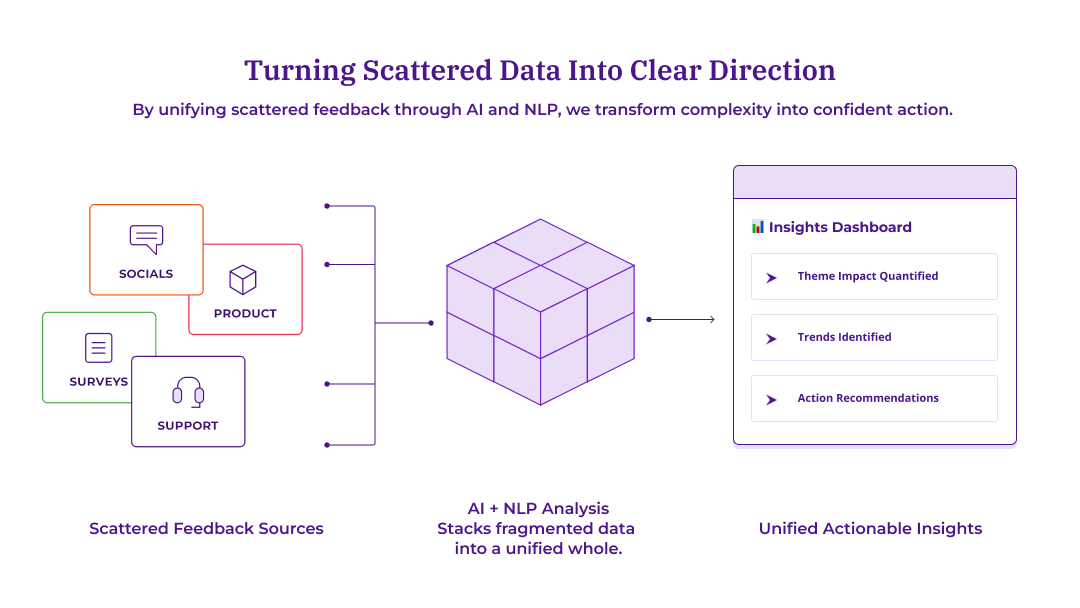
AI-powered analytics unifies fragmented feedback channels into a single insights dashboard with quantified themes, trend analysis, and prioritized recommendations.
Why enterprise customer feedback analytics is different
Enterprise customer feedback analytics isn't just scaled-up SMB tools. Three things change what you need: scale, integration complexity, and governance requirements.
Processing 100K+ feedback items across channels
At enterprise scale, you're not analyzing one survey. You're unifying feedback from surveys, reviews, support tickets, chat logs, social media, and in-app comments. Often across multiple brands, regions, and product lines.
The challenge? Each channel told only part of the story. They needed to see the complete picture.
With the right customer feedback analytics platform, this unification happens automatically. Modern enterprise solutions offer native connectors for major survey tools, contact center platforms, review sites, and CX systems.
You can connect new data sources within hours through native connectors, API, sFTP, or file upload. You don't have to wait on professional services engagements or build custom integrations. Compared to implementations that require months of consultant-led configuration, this dramatically reduces time to value.
Governance that stands up to scrutiny
Enterprise teams deal with regulations like GDPR, CCPA, and SOC 2. Your platform needs to handle data security, access controls, and audit trails. But there's something equally important.
Your insights need to hold up when questioned. When executives challenge your analysis or when you're presenting to the board, you need clear answers. You need to trace conclusions back to actual customer feedback. You need to explain how themes were identified.
The impact of getting it right
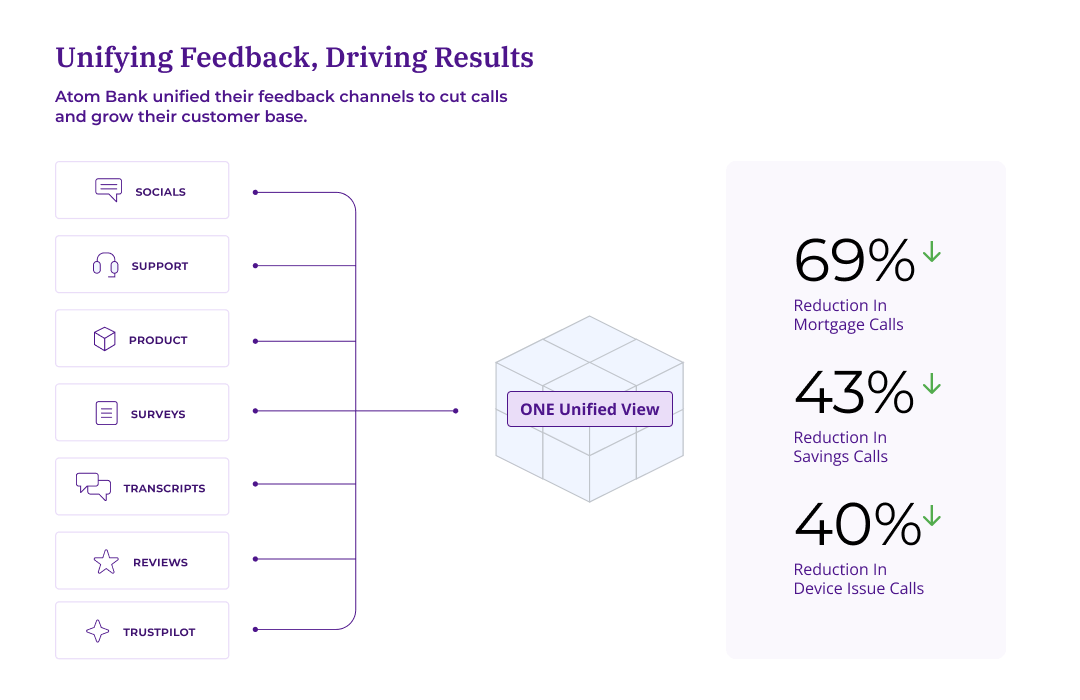
Atom Bank unified their 7 feedback channels and 3 product lines. By looking at the complete customer experience instead of isolated feedback streams, they made targeted improvements that actually worked.
They reduced calls about unaccepted mortgage requests by 69%. Savings maturities calls dropped by 43%. Device issues calls fell by 40%. All while growing their customer base 110% year-over-year.
Michael Sherwood, Head of CX at Atom Bank, explains: "Thematic lets us quickly turn unstructured feedback from across channels into clear insights that directly inform our product roadmap and corporate strategy."
Atom Bank unified feedback from seven channels into a single view, reducing call volumes by up to 69% across key service categories.
What makes customer feedback analytics transparent (and why it matters)
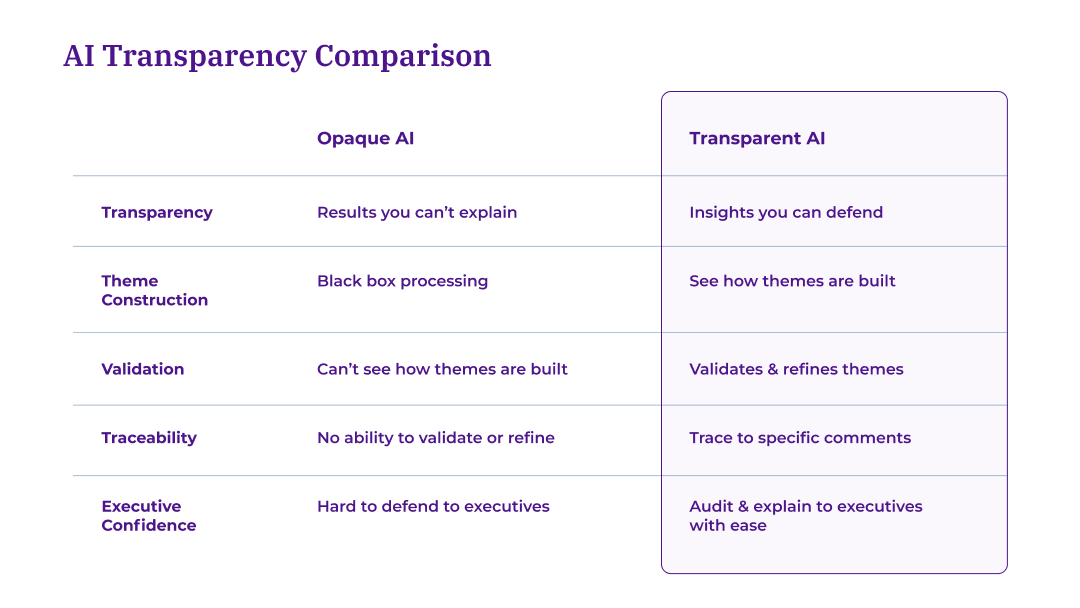
Three things make customer feedback analytics transparent: you can see how themes are built, you can validate and refine the AI's logic, and you can trace every conclusion back to specific customer comments. This matters because you can't defend insights you can't explain.
The Transparency Gap
One capability that often gets overlooked during vendor evaluation: visibility into how themes are identified and built. Some platforms provide outputs without letting you see or refine the underlying logic.
Different approaches handle this differently. Some require you to define categories upfront and train the AI with thousands of labeled examples, which means you only find what you thought to look for.
Others use statistical word grouping that might cluster "fast delivery" and "fast food" together because they share vocabulary, not meaning.
Transparent AI discovers themes from the data itself, letting unexpected patterns surface automatically while giving you control to refine what it finds.
You get outputs, but you can't audit the logic. You can't refine themes to match your business terminology. You can't trace insights back to actual customer comments.
Think of it like showing your work in math class. The answer matters, but so does the reasoning behind it. When you're presenting customer intelligence to executives who control budgets and strategy, "the AI said so" isn't good enough.
Why transparency matters for enterprise
When you're presenting customer intelligence to executives who control budgets and strategy, stakeholders expect to see the reasoning behind recommendations.You need to show your work.
You need to demonstrate that "merchant frustration" is a real pattern backed by specific feedback, not an AI hallucination. When NPS drops 5 points, you need to know exactly which themes drove that decline. You need to trace the impact back to verifiable customer comments.
Transparent customer feedback analytics means you can see how themes are identified and built. You can refine them when needed. This matters when you need to audit your AI for compliance, when you need to defend insights to executives, and when you need humans to validate what the AI discovered.
How transparent AI actually works
As the AI groups similar comments based on meaning, you can see exactly which comments it put together and why. If a grouping doesn't make sense for your business, you adjust it.
When you rename a theme to match your terminology, the underlying customer meaning stays intact. This visibility is what makes the difference between insights you hope are right and insights you can verify.
As it builds these groupings, you can see exactly which comments the AI put together and why. If you spot a grouping that doesn't make sense, you can adjust it. When you rename a theme to match your business terminology, the underlying customer meaning stays intact.
Greyhound saw this transparency in action. The AI discovered themes they never would have coded manually because it identified patterns their analysts had missed.
But because they could see how those themes were built and validate them, they trusted the results enough to act immediately. Their analytics time dropped from 3 hours-3 days down to minutes.
The business impact of transparency
Transparency gives you the confidence to take decisive action on insights. When you can trace themes back to specific feedback and validate the patterns, you can redesign products, change processes, and make investments without second-guessing the analysis.
The issue? Their Menu Manager tool took 11 seconds to load each edit. Merchants had to scroll back to the top of their menu every time they deactivated an item.
Because DoorDash could trace the theme back to specific merchant feedback and validate the pattern, they had the confidence to redesign the interface. The result: load times dropped from 11 seconds to under 3 seconds. Merchant satisfaction soared.
This level of precise action is only possible when your customer feedback analytics platform shows you exactly why customers feel the way they do. With evidence you can verify.
Opaque AI delivers results you can't explain. Transparent AI delivers insights you can defend, trace, and present to executives with confidence.
How do you measure ROI from customer feedback analytics?
Enterprise teams measure ROI from customer feedback analytics through four lenses:
Time savings (how much faster you get to insights)
Revenue opportunities (what you discover in feedback)
Capacity freed (hours returned to strategic work).
Impact analysis: Quantifying what moves your metrics
Impact analysis identifies which themes actually hurt your metrics. Advanced platforms move beyond counting mentions to measuring point drag. That's the exact NPS or CSAT impact each theme creates.
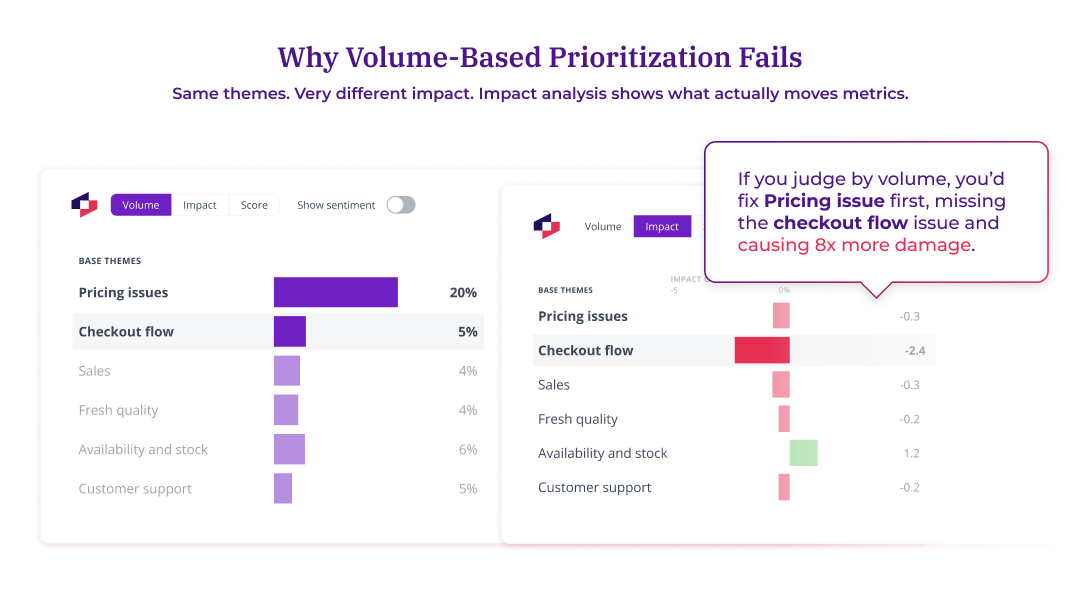
Consider a common scenario: A theme mentioned by 5% of customers causes a -2.4 point NPS impact, while a theme mentioned by 20% causes only -0.3 points. If you prioritize by volume, you miss the high-impact issue entirely.
Impact-based analysis shows you which 3-5 issues to fix first. The ones that will actually recover points.
Volume-based prioritization can mislead teams. In this example, fixing the highest-volume issue first would miss the checkout flow problem causing 8x more damage to key metrics.
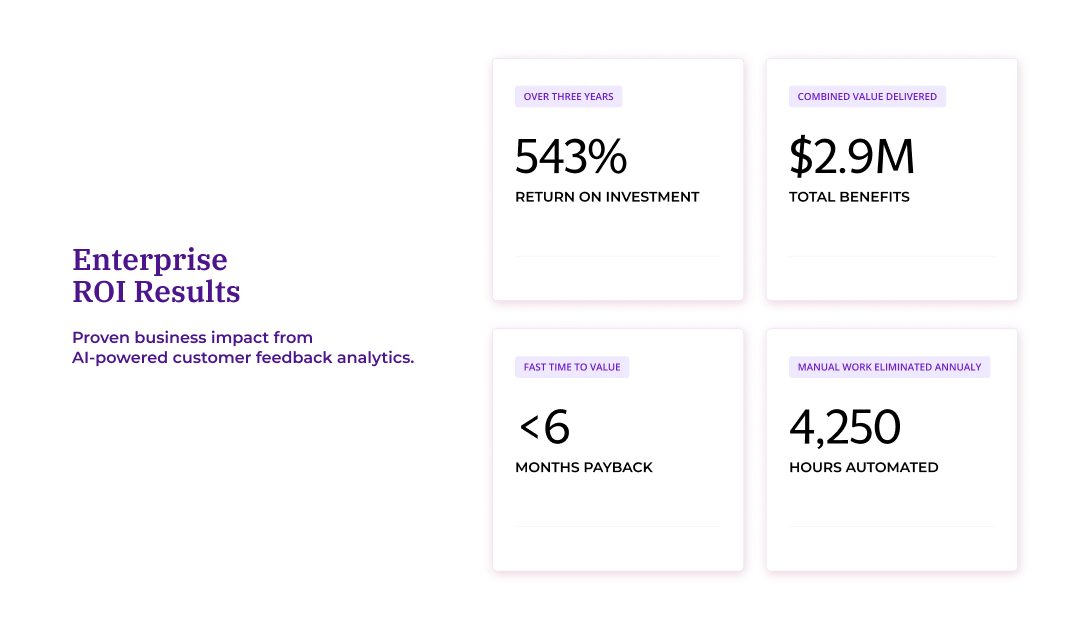
According to the Forrester Total Economic Impact study, enterprises using Thematic for AI-powered customer feedback analytics see 543% ROI over three years. They see $2.9M in total benefits.
The study found that impact-based analysis delivered these results by focusing teams on fixes that actually move metrics. Not chasing the loudest complaints.
Proven enterprise impact from AI-powered customer feedback analytics: 543% three-year ROI, $2.9M in total benefits, and 4,250+ hours of manual analysis eliminated annually.
Time savings that compound
Analysis speed directly affects how fast you can act on customer issues. With Thematic, a large grocery retailer cut their analysis time by 92%, from a week to under a day.
This speed gain meant they could analyze feedback weekly instead of quarterly. They caught emerging issues before they became crises and identified $4.8M in annual revenue opportunities.
Greyhound achieved similar results, reducing analysis time from weeks to minutes. This velocity transformation freed their team to focus on action rather than analysis. It also reduced dependency on external consultants for ongoing analytics work, protecting their insights capability from budget fluctuations.
Revenue opportunities discovered in feedback
The same Forrester Total Economic Impact study found that improved customer experience through AI-powered customer feedback analytics generated $1.8M in incremental income over three years for the studied organization.
This came from reducing cart abandonment by identifying and fixing CX issues customers explicitly mentioned: product problems, complicated processes, and service delays.
Customers were requesting these improvements in their feedback. But without impact-based prioritization, teams hadn't known which issues to fix first.
The large grocery retailer achieved 4.75% business growth by using customer feedback analytics to identify department-specific impacts. They discovered that Fruit & Veg had a -1.3 NPS impact, Meat -0.9, and Bakery -0.8.
By targeting improvements to these specific departments based on what customers were saying, they captured $4.8M in annual revenue from customer-driven initiatives.
Capacity freed for strategic work
The Forrester study also found that enterprises automate 4,250 hours of manual work annually with modern platforms. That's time your team can spend on strategy instead of spreadsheets.
LendingTree saves hundreds of hours in data prep and analysis. Their Insights team focuses on recommendations instead of manual coding. Atom Bank increased their feedback processing capacity by 12.5x with the same team size.
This matters because it changes what customer feedback does for your organization. It stops being just a reporting function. It becomes strategic intelligence that shapes product roadmaps, marketing positioning, and operational decisions.
Getting started with customer feedback analytics
Once you've seen the ROI potential, the question becomes: which platform delivers it?
When evaluating platforms, focus on four capabilities that separate sophisticated solutions from basic text analytics.
Before choosing a feedback analytics platform, evaluate these four enterprise-ready capabilities: transparency, speed to value, impact measurement, and seamless integration.
1. Transparency and defensibility
Can you see how themes are identified, validate the AI's logic, and trace insights back to actual comments?
For enterprise teams presenting to executives or working in regulated industries, this capability is essential.
2. Time to value
Does the platform work immediately, or require months of consultant-led implementation?
With the right platform, you can prove ROI during a pilot rather than spending months on configuration before seeing any value.
3. Impact quantification
Does the platform show what matters to your business, or just what's mentioned most?
The best solutions quantify exact NPS or CSAT point impact for every theme, helping you prioritize by business impact rather than volume.
4. Integration with your existing stack
Can the platform connect to your surveys, contact center, and CX platforms within hours?
For enterprises with feedback across 10+ systems, seamless integration determines whether you get a unified view or another siloed tool.
Beyond CX suites, enterprise buyers often evaluate purpose-built text analytics tools: Chattermill and Enterpret focus on multi-channel ingestion and automation, Kapiche handles high-volume data with AI-powered deeper analysis, and Dovetail is oriented toward qualitative research teams managing interviews and transcripts.
The key distinction is scope. These tools typically specialize in one part of the workflow: either collecting feedback, analyzing it, or routing it. Thematic's Customer Intelligence and Activation system covers the full loop: unsupervised theme discovery, impact analysis that ties themes to business metrics, team-specific Lenses for cross-functional access, and the Actions Agent to close the loop at scale.
Turning feedback into competitive advantage
The enterprises getting this right aren't treating customer feedback as a reporting obligation. They're using it as strategic intelligence that shapes product decisions and catches emerging issues before they become crises.
The platform you choose determines whether feedback becomes a bottleneck or a competitive advantage: transparent AI that shows its work, impact analysis that prioritizes what matters, integration that unifies scattered feedback sources, and time to value measured in days, not months.
Thematic combines all four: transparent, research-grade AI with multi-channel integration and impact analysis, sitting on top of your existing CX platforms.
See how teams at DoorDash, LendingTree, Greyhound, and Atom Bank turned customer feedback into insights they could act on and defend through these customer intelligence case studies.
Alternatively, book a demo with us to see how you can turn your data into action with customer feedback analytics.
Frequently asked questions
How accurate is AI-powered customer feedback analytics?
Modern platforms achieve 80%+ accuracy out-of-the-box when discovering themes automatically. This gets better over time as analysts refine themes through human validation.
Not all solutions hit this level. Thematic achieves 80%+ accuracy immediately by combining automated discovery with transparent validation. Researchers can verify and refine themes through an intuitive editor.
How do I get started with AI-powered customer feedback analytics?
Start with a clear pilot scope. Identify one high-value feedback source (like your NPS survey or support tickets). Identify one business question you need answered (like "what's driving our declining NPS?").
With the right platform, you can connect this data source and start analyzing within hours. Not months. LendingTree connected 10 data sources across 7 product verticals and started extracting insights with zero setup time.
For enterprises, prove ROI on a single use case during a pilot. Then expand to additional feedback sources once stakeholders see the impact.
Does AI replace human analysts in customer feedback analytics?
No. AI helps analysts work smarter, not replaces them. The best setups combine AI's ability to process massive scale with human expertise in validation and strategic thinking.
AI surfaces patterns at scale that humans would never find manually. It processes 20,000+ comments in minutes. It spots themes you didn't know to look for. But humans validate those themes, refine them to match business language, and turn findings into recommendations that drive action.
Atlassian processes 60,000 pieces of customer feedback every month. They selected Thematic from 36 vendors to help them scale their analysis. The AI handles the volume consistently, without the variation that comes from different analysts interpreting feedback differently.
How long does enterprise implementation take for customer feedback analytics?
Much faster than implementations that require extensive professional services. With the right customer feedback analytics platform, you can connect new data sources within hours, not months.
Compare this to platforms that require months of consultant-led configuration, model training, and rule building. Modern AI-powered customer feedback analytics delivers value immediately while you're still in the pilot phase.
What's the difference between customer feedback analytics and customer feedback management?
They serve different purposes. Customer feedback management handles collection, organization, and response workflows. Customer feedback analytics uses AI to discover patterns, quantify business impact, and surface actionable insights from that feedback.
How does Thematic compare to other customer feedback analytics tools?
Thematic is a purpose-built customer intelligence and activation layer designed to analyze unstructured feedback at scale, connect themes to business metrics, and push insights to the teams that need them. It sits within a best-of-breed CX stack rather than replacing existing tools.
Compared to full CX suites (Medallia, Qualtrics, InMoment): These platforms offer strong survey engines and broad CX workflow capabilities. Thematic complements them as a dedicated analytics layer. Over half of Thematic customers also use Qualtrics or Medallia for feedback collection. The difference is in speed and accessibility: Thematic deploys in approximately 3 days with self-serve analysis, while suite text analytics modules typically require 2 to 4 weeks of professional services for setup and ongoing PS engagement for customization.
Compared to AI text analytics tools (Chattermill, Enterpret, Kapiche): These platforms share Thematic's focus on AI-powered feedback analysis. Thematic differentiates through transparent, research-grade methodology (full audit trails and comment-level verification), unsupervised theme discovery that surfaces patterns without predefined categories, and impact analysis that quantifies how each theme affects NPS, CSAT, and other business metrics.
Compared to qualitative research tools (Dovetail): Dovetail is designed for research teams managing interviews and user studies. Thematic is built for continuous, large-scale VoC programs that process thousands of comments across multiple channels on an ongoing basis.
Compared to action-oriented feedback tools (Zonka Feedback): These tools focus on real-time alerts, ticket routing, and closing the feedback loop operationally. Thematic provides deeper analytical capabilities: understanding why customers feel a certain way, which themes drive metric movements, and where to focus resources for the greatest business impact.
Share
Link Copied!
Request a demo of Thematic's Customer Intelligence Platform
Thematic turns fragmented feedback into one consistent source of customer truth — so every team acts on the same customer story. Up and running in days, not quarters.
Thank you! Your submission has been received!
Oops! Something went wrong while submitting the form.